Lots of people recently have been convinced by John Howard Yoder that the pre-Constantinian church fathers were all pacifists and then, in the fourth century, like the French Communist Party receiving news of the new party line from Moscow in 1941, abruptly reversed themselves and suddenly people like Augustine became rabid theocrats. So the answer to the question in the title of this post would be "Yes!" First they were pacifists and then suddenly they did a 180 degree turn over night. Is this a convincing reading of early church history?
In this post at First Thoughts a while back, Matthew Lee Anderson tentatively suggested that J. Daryl Charles just might be right - and John Howard Yoder wrong - about the stance of the church fathers on pacifism. Yoder famously said that the fathers up to the end of the third century were pacifists (though he thought that their convictions unfortunately weakened a bit during the "long peace" in the second half of the third century between the 9th and 10th great waves of persecution). In opposition to this view, Anderson reports, Charles argues that there is a great deal of ambiguity in the teachings of the Fathers on the issue of serving in the Roman army and pacifism with no evident consensus.
Now, we also must remember that Yoder famously lumped Augustine in with Eusebius and Constantine as creators of what he called "Christendom," which according to Yoder means something like a totalitarian theocracy - kind of like contemporary Iran with bishops replacing the mullahs.
Anderson quotes me offering a rebuttal to Peter Leithart on the meaning of the term "Constantinianism" in Yoder's writings. I pointed out that for Yoder, Constantinianism is an eschatological heresy, not an historical conclusion about what happened in the fourth century. For Yoder, Constantinianism is an illegitimate attempt to reach forward into the future and pull the kingdom of God into the present as if the kingdom had already come in its fullness. This idea is wrong whenever it pops up in history and if it isn't in a particular century or place that does not affect its existence as a theological idea. Well, I still think that is true, but I think Yoder also did contend that the church from the fourth century onward did fall into Constantinianism and Leithart is right about that.
So is Yoder right about the pre-Constantinian Fathers? Is he right about Augustine? Is he right about the "Constantinian Shift"? Is he right about "Constantinianism" being an eschatological heresy? Let's go one at a time.
1. Is Yoder right about the pre-Constantinian Fathers being pacifists? I now think that Charles and those who see more ambiguity in the first three centuries have the better of the argument. It is difficult to be categorical but the most I think we can say is that some early Christians took a pacifist position. But there is nothing decisive like the inclusion of the homoousion in the Nicene Creed to prove that it was an agreed upon doctrine of the ecumenical church. Yoder's view is not supportable by the facts.
2. Is Yoder right about Augustine? I have now read Augustine for myself and I am a bit embarrassed to report that Yoder is spectacularly wrong to lump Augustine in with Eusebius. Yes, the young Augustine got caught up in the excitement of the Theodosian settlement after his conversion in 386. But from about the middle of the 390s onward he gradually worked his way free of these assumptions through his biblical studies and by 410 was in a position to articulate his mature eschatology in The City of God. He renounced Eusebian postmillennialism and adopted his amillennial eschatology of the two cities, in which the State becomes part of the secular - that which belongs to this age - and is thoroughly desacralized. The doctrine of the separation of church and state is rooted in Augustine's thought and there is no basis for theocracy in The City of God.
3. Is Yoder right about the "Constantinian Shift"? I have to say that I think it is overblown by Yoder for one very good reason. Although there is a shift in that the church embraces the state to a considerable extent, the pacifist impulse continues in the form of monasticism while the impulse of the church to partner with the state has more precedents in pre-third century thought that Yoder would have us believe. So there is evolution but not a sudden, wrenching, 180 degree about face.
4. Is Yoder right about "Constantinianism"? I think he is both right and wrong about what he calls "Constantinianism." I think that the term is unfortunate, as is the tendency to equate "Christendom" with "Theocracy." More is obscured by this terminology than is illumined. First, the theologically illegitimate reaching forward and pulling the kingdom back into the present is a perennial temptation of both liberal and conservative, or, better, Romantic Utopian and Coercive Theocratic theologies.
Liberal Pacifism is an example of the former tendency and it is heretical because it envisions the perfection of human nature by the reform of political institutions, which is impossible. The Spanish conquest of the Americas and forced conversion of native peoples is an example of Coercive Theocracy.
I do believe there are examples of tendencies toward theocracy in Western history, although one hates to say so just because the Left unfairly blows them all out of proportion and defines theocracy as Christian morality having any influence on public affairs whatsoever. But where theocratic tendencies do pop up, they are betrayals of Augustinian theology, not implementations of it.
The Bottom Line
The really important point to see is that both Romantic-Utopian and Coercive-Theocratic theologies are both rooted in the same postmillennialist attempt to bring about the kingdom of God here and now within history and without the spectacular Divine intervention the NT refers to as the Return of Christ.
One of the implications of this insight is that Romantic-Utopian and Coercive-Theocratic theologies are not as different from each other as proponents of both might think. Certainly, all attempts to impose Utopian schemes in history tend to degenerate quickly into coercion and violence. This is true of medieval millennial movements, the 16th century peasants revolts and various kinds of Marxist revolutions in the 20th century.
In contrast to all these stands the Augustinian amillennialist, two cities doctrine in which the state and church are kept separate and the state is seen as potentially good and potentially evil in this age. Christians are encouraged to work within the state, but not to sacralize it. Between pacifism and revolution lies the just war doctrine to guide moral decision-making on issues of defending good and repelling evil while realizing that the final defeat of evil will not occur within this age of history as we know it.
The bottom line is that the Church Fathers were neither Utopian pacifist nor warmongering theocrats and we ought to follow their example.
Showing posts with label Christendom. Show all posts
Showing posts with label Christendom. Show all posts
Monday, September 26, 2011

Monday, January 31, 2011
Yoder, Augustine and Christendom: What is the Real Politics of Jesus?
I continue to ponder the implications of Peter Leithart's brilliant answer to John Howard Yoder in his Defending Constantine: The Twilight of Empire and the End of Sacrifice. I am trying to think through the question of why Yoder advocates a minority church and pacifism for all disciples as the core of that minority church and why he rejects all of Christendom as "Constantinian" and thus heretical.
The problem I have with Yoder at this point is that as Yoder's influence grows and spreads among left-wing Evangelicals and liberal Protestants alike, the theology that emerges from those who are influenced by him is, all too often, individualistic and privatized. For example, many (most) of those influenced by Yoder are acquiescing in the redefinition of marriage by the State.
Now, the Evangelical Left, which is influenced by Yoder, will jump all over me at this point and angrily deny my charge on the basis that they have embraced a socialist ideology which they see as communal. In their account, it is the conservative Evangelicals who are buying into modernity by accepting the marginalized place the church is afforded in late modernity. They are different because they proclaim peace and justice and concern for the poor expressed in welfare statism or democratic socialism.
But what if socialism and the liberal democratic state are simply parodies of true community? What if, as Alasdair MacIntrye recognized, they mask a deep individualism at their roots which is more modern than Christian? Suppose we apply an Augustinian analysis to the modern welfare state. Should we not conclude that the modern state is - precisely to the extent that it privatizes Christianity - deeply idolatrous and pagan?
In the light of these musings, listen to Stanley Hauerwas' comments on Defending Constantine.
Implicit in the ceasing of sacrifice is the recognition of the Church as an alternative polity, a community which proclaims the sacrificial death of Jesus Christ as the call to worship the True God alone through the sacrifice of Christ and therefore to cease from sacrificing to the gods. Yet, in recognizing the Lordship of Christ, the State does not become a Christian State in the sense of the Church taking over the State; instead the State recognizes the existence and legitimacy of an alien polity within its territory - the Church. The Church is the embodiment of true religion so the State no longer has to be religion in and of itself. It is Christian precisely by being secular.
The Church is the node at which Christendom connects to Divine Revelation and therefore its preaching of God's will has authority for all within Christendom including rulers. But rulers still rule according to prudence and are justified in making space within Christendom for dissenters (Jews, pagans, Muslims, atheists). This is where tolerance came from historically. The Church proclaims moral truth; rulers practice statecraft. We have two sources of authority in society, not just one. Neither the Church leaders or the political leaders are all-powerful.
The problem with Yoder is that his view of conversion is all or nothing. For him, either Constantine becomes a pacifist or he remains pagan. The conversion of the state, for Yoder, can only mean a theocracy and he, quite understandably, cannot imagine a violent theocracy being a proper witness to Jesus Christ in this world. (It is significant that separated Anabaptist communities have quite often become Constantinian mini-Christendoms.).
Yoder failed to recognize that for a state to be converted might look different from what it would mean for an individual to be converted. We as individuals are not converted to secularism, but to Christian discipleship. For you or me, to become a Christian means to worship God through Christ. But for the state to be converted means for it to cease sacrifice and not presume to worship at all. Why? Because it recognizes that worship happens in the Church and that the State is not the Church.
Yoder has to dismiss all Christendom as Constantinian and evil because he does not recognize that there are three, rather than two, ways for the State to be the State. The State can either be a pagan idolatrous State or a Theocratic, Church-dominated State, but it can also be a modest, limited government that recognizes that it is not ultimate or Divinely sanctioned in and of itself. It can recognize its limits precisely by doing what Constantine did: that is, by ending sacrifice and recognizing the truth of the Gospel and the role of the Church as a polity distinct from the State with its own proper role to play in Christendom.
Such a State will not presume to re-define marriage by fiat, nor will it authorize the killing of the pre-born, the young, the sick, the elderly or the handicapped. It will not require its citizens to be practicing Christians, but it will encourage them to be such. It will give many advantages to the Church, make holidays conform to the Christian calendar and seek to promote marriage and the family as the foundations of a healthy society. It will be open to civil society and avoid totalitarian tendencies to meddle in the lives of individuals to the extent compatible with law and order. It is appropriate to call such a State "Christian" so long as you know what that means. You know what it means if you can give an account of why a "Christian" State must be secular and give individuals the freedom to believe or not.
It is my conviction that Yoder's theology plays into the hands of late modern, Statism by not calling the State to the conversion that is proper to the state. Because of this error, Yoder can only imagine a minority Church ever existing and thus he equates Christendom with unfaithfulness. Meanwhile, the State is left free to proceed on the path to its own divinization. Just as the Roman Emperors gradually began to accept worship, so the late modern State gradually assumes Divine prerogatives.
To hold, as Yoder does, that the State cannot be converted without becoming pacifist and thus committing suicide, is to determine ahead of time what God's Spirit is allowed and not allowed to do in history. If Kenya, for example, goes from being 9% Christian in 1900 to being 91% Christian in 2000, (which it did), then we have Christendom like it or not. A true Christian political theology must allow for such a possibility and have something constructive to say to Christian politicians in Kenya. What is has to say is the true politics of Jesus, but ironically we need to look to the Augustinian tradition rather than the Anabaptist tradition for help in spelling out that politics.
The problem I have with Yoder at this point is that as Yoder's influence grows and spreads among left-wing Evangelicals and liberal Protestants alike, the theology that emerges from those who are influenced by him is, all too often, individualistic and privatized. For example, many (most) of those influenced by Yoder are acquiescing in the redefinition of marriage by the State.
Now, the Evangelical Left, which is influenced by Yoder, will jump all over me at this point and angrily deny my charge on the basis that they have embraced a socialist ideology which they see as communal. In their account, it is the conservative Evangelicals who are buying into modernity by accepting the marginalized place the church is afforded in late modernity. They are different because they proclaim peace and justice and concern for the poor expressed in welfare statism or democratic socialism.
But what if socialism and the liberal democratic state are simply parodies of true community? What if, as Alasdair MacIntrye recognized, they mask a deep individualism at their roots which is more modern than Christian? Suppose we apply an Augustinian analysis to the modern welfare state. Should we not conclude that the modern state is - precisely to the extent that it privatizes Christianity - deeply idolatrous and pagan?
In the light of these musings, listen to Stanley Hauerwas' comments on Defending Constantine.
It seems to me that what Leithart sometimes calls the "desacrificing" of the Empire, and other times the "baptism" of the Empire, could also be called the "conversion of the Empire." But misunderstanding lurks at every turn here. This "conversion" is the renouncing of idolatry by the Empire, not the turning of the Roman State into the Church. When the State becomes a Church we have a deformation of Christendom. Rather, what happens when the Roman State ceases sacrificing to the gods is that it becomes secular (i.e. belonging to this age between the two comings of Christ, destined to pass away at the end of the age).Leithart does not think his disavowal of pacifism means he has to reject Yoder's contention that Jesus has a politics. In order to defend his own understanding of the politics of Jesus, he introduces a theme I can only hope he will develop in the future: his defense of Constantine turns on his claim that as a Christian, Constantine ended the Roman sacrificial system. Accordingly Constantine "desacrificed" the Roman political order because he understood that Jesus was the end of sacrifice. The church, for Augustine, is the embodiment of Christ's sacrifice, and this creates a new political reality necessary to keep the state appropriately modest.
Implicit in the ceasing of sacrifice is the recognition of the Church as an alternative polity, a community which proclaims the sacrificial death of Jesus Christ as the call to worship the True God alone through the sacrifice of Christ and therefore to cease from sacrificing to the gods. Yet, in recognizing the Lordship of Christ, the State does not become a Christian State in the sense of the Church taking over the State; instead the State recognizes the existence and legitimacy of an alien polity within its territory - the Church. The Church is the embodiment of true religion so the State no longer has to be religion in and of itself. It is Christian precisely by being secular.
The Church is the node at which Christendom connects to Divine Revelation and therefore its preaching of God's will has authority for all within Christendom including rulers. But rulers still rule according to prudence and are justified in making space within Christendom for dissenters (Jews, pagans, Muslims, atheists). This is where tolerance came from historically. The Church proclaims moral truth; rulers practice statecraft. We have two sources of authority in society, not just one. Neither the Church leaders or the political leaders are all-powerful.
The problem with Yoder is that his view of conversion is all or nothing. For him, either Constantine becomes a pacifist or he remains pagan. The conversion of the state, for Yoder, can only mean a theocracy and he, quite understandably, cannot imagine a violent theocracy being a proper witness to Jesus Christ in this world. (It is significant that separated Anabaptist communities have quite often become Constantinian mini-Christendoms.).
Yoder failed to recognize that for a state to be converted might look different from what it would mean for an individual to be converted. We as individuals are not converted to secularism, but to Christian discipleship. For you or me, to become a Christian means to worship God through Christ. But for the state to be converted means for it to cease sacrifice and not presume to worship at all. Why? Because it recognizes that worship happens in the Church and that the State is not the Church.
Yoder has to dismiss all Christendom as Constantinian and evil because he does not recognize that there are three, rather than two, ways for the State to be the State. The State can either be a pagan idolatrous State or a Theocratic, Church-dominated State, but it can also be a modest, limited government that recognizes that it is not ultimate or Divinely sanctioned in and of itself. It can recognize its limits precisely by doing what Constantine did: that is, by ending sacrifice and recognizing the truth of the Gospel and the role of the Church as a polity distinct from the State with its own proper role to play in Christendom.
Such a State will not presume to re-define marriage by fiat, nor will it authorize the killing of the pre-born, the young, the sick, the elderly or the handicapped. It will not require its citizens to be practicing Christians, but it will encourage them to be such. It will give many advantages to the Church, make holidays conform to the Christian calendar and seek to promote marriage and the family as the foundations of a healthy society. It will be open to civil society and avoid totalitarian tendencies to meddle in the lives of individuals to the extent compatible with law and order. It is appropriate to call such a State "Christian" so long as you know what that means. You know what it means if you can give an account of why a "Christian" State must be secular and give individuals the freedom to believe or not.
It is my conviction that Yoder's theology plays into the hands of late modern, Statism by not calling the State to the conversion that is proper to the state. Because of this error, Yoder can only imagine a minority Church ever existing and thus he equates Christendom with unfaithfulness. Meanwhile, the State is left free to proceed on the path to its own divinization. Just as the Roman Emperors gradually began to accept worship, so the late modern State gradually assumes Divine prerogatives.
To hold, as Yoder does, that the State cannot be converted without becoming pacifist and thus committing suicide, is to determine ahead of time what God's Spirit is allowed and not allowed to do in history. If Kenya, for example, goes from being 9% Christian in 1900 to being 91% Christian in 2000, (which it did), then we have Christendom like it or not. A true Christian political theology must allow for such a possibility and have something constructive to say to Christian politicians in Kenya. What is has to say is the true politics of Jesus, but ironically we need to look to the Augustinian tradition rather than the Anabaptist tradition for help in spelling out that politics.
Friday, October 22, 2010
Church and State: How They Should Relate
The fundamental point here is that the Church and State each have a Divinely-appointed role to play in this fallen world between the first and second comings of Christ. The Church's main role is to fulfill the Great Commission and disciple people into a life of growing sanctification and increasing obedience to all that Christ commands. This has tremendously important public and political implications because Christian citizens in a Christian majority country - as voters, as elected office holders and as police officers, judges, and other agents of the government - will have a lot to say about what government does and does not do.
Christians function, as Jesus taught, as salt and light in the world. They uphold public morality, respect the natural law, promote community and care for neighbors and generally preserve standards of decency. They constitute a force for good in the world and it is through these Christian people that the Church exerts her influence on the State.
When the clergy lead a political movement to take over the power of the State and seek to become the power behind the throne, they discredit the Gospel and embarrass themselves by diverting their focus from their higher calling of preaching the Gospel and shepherding the flock of God. Note, however, that it separation of Church and State, not separation of Christians and State. Nor is it separation of objective, moral truth and State or separation of God and State.
Christendom is a group of countries in which Christians have become the strong majority and the influence of the Church through its member is strong and widespread in society. The government is such countries will therefore adhere to the natural law and recognize the priority of the family and the Church. Separation of Church and State is as much about the protection of the Church from the interfering State as it is about the protection of the State from being dominated by the Church. The right of the Church to teach morality and Divine law to its members and for those members to act on this teaching in the public square is fundamental to a free society.
When the State refuses to recognize the natural law and becomes lawless and tyrannical in its usurpation of absolute power unto itself, it needs correction and the Church has a crucial role to play. A Church which does not teach its members to oppose such a tyrannical State and attempt by democratic means to bring correction by electing a government committed to modesty and humility before God and the moral order of the universe is not doing its job.
We cannot allow the shrill, extreme and angry voices of the New Atheism or the Secularists or the Socialists to silence either Christians or their Churches if we wish to be salt and light in the world. We cannot allow modern Sophists to drive those committed to the Truth out of the public square. We should not be intimidated by those who equate any witness to the obvious truth of the objective moral order in the world to theocracy or other such ridiculous charges. Such extremism has gone unchallenged for far too long and the enemies of humanity have been emboldened by Christian reticence. It is time to say enough destruction of the ideals of limited government, the division of powers, individual liberty, free speech, free enterprise, freedom of religion, natural law, equality of opportunity and human dignity. It is time to stand for freedom to do the good in opposition to a watered-down, emaciated, modern idea of freedom as the ability to indulge the fleeting desires of the moment without constraint.
While the State bears the sword and is the supreme authority in the land, it has the responsibility to respect and bow to the law of God. The responsibility of the Church is to make sure that the law of God is never allowed to recede from view or be twisted into the will to power.
Christians function, as Jesus taught, as salt and light in the world. They uphold public morality, respect the natural law, promote community and care for neighbors and generally preserve standards of decency. They constitute a force for good in the world and it is through these Christian people that the Church exerts her influence on the State.
When the clergy lead a political movement to take over the power of the State and seek to become the power behind the throne, they discredit the Gospel and embarrass themselves by diverting their focus from their higher calling of preaching the Gospel and shepherding the flock of God. Note, however, that it separation of Church and State, not separation of Christians and State. Nor is it separation of objective, moral truth and State or separation of God and State.
Christendom is a group of countries in which Christians have become the strong majority and the influence of the Church through its member is strong and widespread in society. The government is such countries will therefore adhere to the natural law and recognize the priority of the family and the Church. Separation of Church and State is as much about the protection of the Church from the interfering State as it is about the protection of the State from being dominated by the Church. The right of the Church to teach morality and Divine law to its members and for those members to act on this teaching in the public square is fundamental to a free society.
When the State refuses to recognize the natural law and becomes lawless and tyrannical in its usurpation of absolute power unto itself, it needs correction and the Church has a crucial role to play. A Church which does not teach its members to oppose such a tyrannical State and attempt by democratic means to bring correction by electing a government committed to modesty and humility before God and the moral order of the universe is not doing its job.
We cannot allow the shrill, extreme and angry voices of the New Atheism or the Secularists or the Socialists to silence either Christians or their Churches if we wish to be salt and light in the world. We cannot allow modern Sophists to drive those committed to the Truth out of the public square. We should not be intimidated by those who equate any witness to the obvious truth of the objective moral order in the world to theocracy or other such ridiculous charges. Such extremism has gone unchallenged for far too long and the enemies of humanity have been emboldened by Christian reticence. It is time to say enough destruction of the ideals of limited government, the division of powers, individual liberty, free speech, free enterprise, freedom of religion, natural law, equality of opportunity and human dignity. It is time to stand for freedom to do the good in opposition to a watered-down, emaciated, modern idea of freedom as the ability to indulge the fleeting desires of the moment without constraint.
While the State bears the sword and is the supreme authority in the land, it has the responsibility to respect and bow to the law of God. The responsibility of the Church is to make sure that the law of God is never allowed to recede from view or be twisted into the will to power.
Christian Influence in the Secular Realm
As I said in the earlier post, Augustine in effect invented the concept of the secular. The secular realm is the space in which Christ's Lordship is contested during this time between the first and second comings of our Lord. In the realm of the secular, it is possible for Christians of varying degrees of commitment and non-Christians to mingle and find some common ground, engage in some disputes but in the end find a way to live together in peace. This has happened in Christendom and is one of its proudest achievements.
Those who consider historic Christendom to be "exclusive," "violent," "patriarchal," and "racist" often do so because they dream of a socialist Utopia in which the legal-constitutional concept of government has been overthrown and the legacy of the West burned to the ground - as in the 20th century Soviet Union, for example. Their critique - which has been internalized by many in the contemporary West through the cultural Marxism commonly referred to as "political correctness" - is overblown, dishonest and impossible to accept.
Christendom has been a geographical area in which there has existed more freedom than has ever existed in any other society in history. Yet this achievement is scorned and demeaned. To criticize Christendom for not having enough freedom is to operate from a Utopian perspective that is not engaged with reality and therefore extremely dangerous.
The question I want to raise here is how Christians exercise influence in the realm of the secular. This is a pressing question for anyone who become convinced of the necessity of a Christian public witness and feels called to serve as a follower of Christ in the public square.
Oliver O'Donovan, in his The Desire of the Nations, discusses the legacy of Christendom and identifies the essence of this legacy as the legal-constitutional conception of government. (240) He writes:
I believe that the reason why so many Evangelicals are attracted to pacifism today is an inarticulate feeling that to teach objective morality and enforce the natural law is tyrannical; that it is merely a Nietzschean imposition of will. Why do they feel this?
O'Donovan points to a sea-change in 17th century political philosophy in which:
The arena of the secular is not a lawless, Nietzschean, war of wills. It is a realm in which Christians, Jews, Muslims and even agnostics can work together on the basis of a common recognition of an objective moral order. Those who reject the natural law or objective moral order are enemies of the common good and must be vigorously opposed. This is precisely what is not happening because of the timidity of Christians and their compromising half-acceptance of atheistic positivism.
The legal-constitutional political order based on a recognition of the unity and inseparability of the natural and Divine law, which is Christendom's legacy to mankind is under attack today as never before. But it is a precious, humanistic and fragile legacy and Christians must defend it in the realm of the secular.
Those who consider historic Christendom to be "exclusive," "violent," "patriarchal," and "racist" often do so because they dream of a socialist Utopia in which the legal-constitutional concept of government has been overthrown and the legacy of the West burned to the ground - as in the 20th century Soviet Union, for example. Their critique - which has been internalized by many in the contemporary West through the cultural Marxism commonly referred to as "political correctness" - is overblown, dishonest and impossible to accept.
Christendom has been a geographical area in which there has existed more freedom than has ever existed in any other society in history. Yet this achievement is scorned and demeaned. To criticize Christendom for not having enough freedom is to operate from a Utopian perspective that is not engaged with reality and therefore extremely dangerous.
The question I want to raise here is how Christians exercise influence in the realm of the secular. This is a pressing question for anyone who become convinced of the necessity of a Christian public witness and feels called to serve as a follower of Christ in the public square.
Oliver O'Donovan, in his The Desire of the Nations, discusses the legacy of Christendom and identifies the essence of this legacy as the legal-constitutional conception of government. (240) He writes:
"Certain key convictions about law became formalised in Christian Europe: all law derives from the will of God; all law is one; all secular rulers are subject to law. . . Christendom in effect refused the classical commonplace that the ruler was a 'living law', his personal authority indistinguishable from the authority of the law he gave. Even those Christians who defended most determinedly the supremacy of the sovereign over earthly courts understood well enough that the sovereign's decree had no legal substance if it ran counter to divine law, natural or revealed." (234) [my bolding]In The Abolition of Man, C. S. Lewis contrasts the situation of the teacher and the pupil with and without the recognition of what he calls the Tao (which is just a fancy name for the natural law). If the existence of natural law is the presupposition of moral education (and public law we could say) then the teacher and the pupil (the ruler and the subject) are both alike under a law that is not of their own making. Each owes obedience to an objective standard that they did not invent and cannot change. So even though one is taught and the other teaches, they are closer to each other than either is to God or the natural law. If the teacher teaches a false doctrine it is not binding on the pupil and will in due course be discovered to the discrediting of the teacher. But if the teacher and pupil assume that there is no such thing as a natural law, then the act of teaching (and we could say the act of governing) becomes essentially tyrannical. It becomes the imposition of the will of the teacher on the pupil.
I believe that the reason why so many Evangelicals are attracted to pacifism today is an inarticulate feeling that to teach objective morality and enforce the natural law is tyrannical; that it is merely a Nietzschean imposition of will. Why do they feel this?
O'Donovan points to a sea-change in 17th century political philosophy in which:
"under the influence of contract-theory, an important shift of emphasis occurred in radical political thought: the ruler's primary responsibility ceased to be thought of as being to divine law, but rather to the people whose supposed act constituted him. This act of popular will came to be thought of as the source of all law and constitutional order." (241)O'Donovan calls this change "a collapse of the idea of a universal Natural Law, and its replacement by a nationalist positivism." (241) This is a key moment in the rise of modern Secularism and our craven, unreflective acceptance of this turn away from God is the cause of our ambiguous waffling in the fight against socialism and our timid retreat into pacifism in the public square.
The arena of the secular is not a lawless, Nietzschean, war of wills. It is a realm in which Christians, Jews, Muslims and even agnostics can work together on the basis of a common recognition of an objective moral order. Those who reject the natural law or objective moral order are enemies of the common good and must be vigorously opposed. This is precisely what is not happening because of the timidity of Christians and their compromising half-acceptance of atheistic positivism.
The legal-constitutional political order based on a recognition of the unity and inseparability of the natural and Divine law, which is Christendom's legacy to mankind is under attack today as never before. But it is a precious, humanistic and fragile legacy and Christians must defend it in the realm of the secular.
Thursday, October 21, 2010
Christendom is Not the Problem: Secularism Is
As a follow-up to my previous post, I want to point out that the eschatological tension that pervades Augustine's thought can be relaxed in two ways, not just one. Readers of my book, Rethinking Christ and Culture, will note that I left the impression that Christendom itself is the problem and that Christendom equals Triumphalism. But Christendom is not the problem, secularism is.
By Secularism, I mean the attempt to disregard, deny or eradicate the future Kingdom of God including the Second Coming, the Day of Judgment and the triumph of Jesus Christ in such a way as to make it all just a symbol of something that actually happens in history. The problem is that this results in pulling the Kingdom back into the present plane of history and cuts the nerve of the eschatological tension between the present Lordship of Christ over the world which is not yet acknowledged by everyone and that future time when every knee will bow and every tongue will confess that Jesus Christ is Lord to the glory of God the Father.
Secularism is not a belief in the validity of the secular. Augustine invented the concept of the secular - that which is neither the sacred or the profane - the sphere of life in which Christians rub shoulders with non-Christians in common endeavors. The secular is the space in which religion and morality is not excluded yet not dominant. The secular allows for dissent and difference of opinion and is inherently anti-totalitarian. But appreciating the secular is not the same as secularism.
Secularism is a term that only entered the English language in the 19th century. It is basically the denial of the transcendent, of God and of an objective moral order. To be secular is to be materialistic and human-centered. Secularism is the expansion of the concept of the secular to encompass the totality of life. Secularism is an attack on Christianity and all religion and morality that is grounded in reality rather than in the will of the individual.
Secularism is as bad as Triumphalism because it both relaxes the eschatological tension and also facilitates the unification of the Church and the State. The difference is that this time the State absorbs the function of the Church into itself. The State makes itself into a god which provides for the people, engineers society according to its own choices and values and makes itself into a source of meaning. The Church is first disestablished, then privatized and finally rendered invisible and impotent. All religious influence must be eradicated from society because such influence constitutes a threat to the power of the State.
The belief in a future Kingdom of God (and by future I mean after the Return of Christ and not continuous with the present age) serves as a check on all totalitarian aspirations, whether they emanate from organized religion or from politics. The direct implication of the maintenance of the belief in the Second Coming, Day of Judgment and Kingdom of God is the relativizing of all politics - both ecclesiastical and civil - and the doctrine of the Two. The doctrine of the Two is the Medieval idea that power should not be concentrated in one set of hands but should be divided between Church and State. The Medieval doctrine of the Two draws on the division of powers in the prophet, the priest and the king in ancient Israel and lays the foundation for the modern concept of the division of powers - the executive, judicial and legislative branches of government - and the the idea of a limited government that does not need to control every action and thought of the people because of the influence of Christianity in creating within the population that self-discipline which is the necessary condition for liberty.
What I am saying is that contemporary Secularism is just as dangerous - in fact, at present it is more dangerous to liberty - than is Triumphalism. Triumphalism is not a clear and present danger in the contemporary West, but Secularism is. There are two roads to totalitarianism: a clerical dominated theocracy like Iran and the "dictatorship of relativism" that arises when secularist ideologies like Marxism become dominant. The alternative to both kinds of totalitarianism is a free Church in a free State: Christendom.
By Secularism, I mean the attempt to disregard, deny or eradicate the future Kingdom of God including the Second Coming, the Day of Judgment and the triumph of Jesus Christ in such a way as to make it all just a symbol of something that actually happens in history. The problem is that this results in pulling the Kingdom back into the present plane of history and cuts the nerve of the eschatological tension between the present Lordship of Christ over the world which is not yet acknowledged by everyone and that future time when every knee will bow and every tongue will confess that Jesus Christ is Lord to the glory of God the Father.
Secularism is not a belief in the validity of the secular. Augustine invented the concept of the secular - that which is neither the sacred or the profane - the sphere of life in which Christians rub shoulders with non-Christians in common endeavors. The secular is the space in which religion and morality is not excluded yet not dominant. The secular allows for dissent and difference of opinion and is inherently anti-totalitarian. But appreciating the secular is not the same as secularism.
Secularism is a term that only entered the English language in the 19th century. It is basically the denial of the transcendent, of God and of an objective moral order. To be secular is to be materialistic and human-centered. Secularism is the expansion of the concept of the secular to encompass the totality of life. Secularism is an attack on Christianity and all religion and morality that is grounded in reality rather than in the will of the individual.
Secularism is as bad as Triumphalism because it both relaxes the eschatological tension and also facilitates the unification of the Church and the State. The difference is that this time the State absorbs the function of the Church into itself. The State makes itself into a god which provides for the people, engineers society according to its own choices and values and makes itself into a source of meaning. The Church is first disestablished, then privatized and finally rendered invisible and impotent. All religious influence must be eradicated from society because such influence constitutes a threat to the power of the State.
The belief in a future Kingdom of God (and by future I mean after the Return of Christ and not continuous with the present age) serves as a check on all totalitarian aspirations, whether they emanate from organized religion or from politics. The direct implication of the maintenance of the belief in the Second Coming, Day of Judgment and Kingdom of God is the relativizing of all politics - both ecclesiastical and civil - and the doctrine of the Two. The doctrine of the Two is the Medieval idea that power should not be concentrated in one set of hands but should be divided between Church and State. The Medieval doctrine of the Two draws on the division of powers in the prophet, the priest and the king in ancient Israel and lays the foundation for the modern concept of the division of powers - the executive, judicial and legislative branches of government - and the the idea of a limited government that does not need to control every action and thought of the people because of the influence of Christianity in creating within the population that self-discipline which is the necessary condition for liberty.
What I am saying is that contemporary Secularism is just as dangerous - in fact, at present it is more dangerous to liberty - than is Triumphalism. Triumphalism is not a clear and present danger in the contemporary West, but Secularism is. There are two roads to totalitarianism: a clerical dominated theocracy like Iran and the "dictatorship of relativism" that arises when secularist ideologies like Marxism become dominant. The alternative to both kinds of totalitarianism is a free Church in a free State: Christendom.
Christendom is not the Problem: Triumphalism Is
In my book, Rethinking Christ and Culture, I fell into the trap of practically (not in theory, but for all intents and purposes) equating Christendom with Triumphalism.
Triumphalism is a perversion of Christendom; it is bad politics arising from heretical doctrine.
Triumphalism means the assimilation of the State into the Church in such a way that the authority of the State is wielded by Church officials to the discrediting of the Church and the detriment of society. Triumphalism arises from the fatal relaxation of the eschatological tension between this age and the next age, the age of the Kingdom of God. Triumphalism carried far enough leads to totalitarianism.
The eschatology of the early Augustine, as is shown by Robert Markus in his magisterial Saeculum: History and Society in St. Augustine, was influenced by the Eusebianism of the age of the Theodosian settlement, which fostered Triumphalism. The dominant eschatology saw the current age as "Christian Times," an era in which biblical prophecy was being fulfilled before the very eyes of the astonished world. The conversion of Rome was seen as the beginning of the coming in history of the Kingdom of God.
As Markus shows, Augustine gradually worked himself free of this eschatology in the process of writing biblical commentaries, especially on Genesis, between roughly 395 and 410 AD. Thus, he was prepared to respond to the crisis following the sack of Rome in 410 when many pagan Roman refugees flooded into North Africa blaming the conversion of Rome to Christ for the disaster.
The eschatology of the mature Augustine emphasized that we live "between the times," that is, between the first and second comings of Christ in a kind of suspension of "salvation history." This is the period of the Church evangelizing the world in fulfillment of the Great Commission, but the Kingdom which appeared in the person of the King, Jesus Christ, remains future in terms of its fulfillment. We live in the Kingdom already, yet the Kingdom has not yet fully come. So we journey through this world as pilgrims, citizens of the city of God yet still in search of that city. One day the city of God will come to earth but this will only occur after the return of Christ.
There is thus an eschatological tension in Augustine's thought between the present age and the future age, the age of the inaugurated kingdom and the kingdom come in its fullness, between the already and the not yet. Our situation is that we live after the coming of Christ and during the reign of Christ, yet not every knee bows and not every tongue confesses at this point in history. So we pray as our Lord taught us: "Thy kingdom come, thy will be done on earth as it is in heaven."
Triumphalism pulls the future kingdom back into the present and supposes falsely that the rule of God is already manifest on earth through the Church. This leads the Church to suppose falsely that it has the authority to abolish the doctrine of the separation of powers between Church and State (between Priest and King) and reunite them in one sacralized entity called the State Church, which is really Leviathan.
Triumphalism is the perennial temptation of Christendom. It has reared its ugly head numerous times in the history of the West, but it represents a deviation, a perversion, a heretical degradation of the true heritage of Christendom, which deserves to be known best not for the Triumphalistic deviation, but for the doctrine of the Two that is the true fruit of Augustinian thought.
Next: Christendom is not the Problem, Secularism Is
Triumphalism is a perversion of Christendom; it is bad politics arising from heretical doctrine.
Triumphalism means the assimilation of the State into the Church in such a way that the authority of the State is wielded by Church officials to the discrediting of the Church and the detriment of society. Triumphalism arises from the fatal relaxation of the eschatological tension between this age and the next age, the age of the Kingdom of God. Triumphalism carried far enough leads to totalitarianism.
The eschatology of the early Augustine, as is shown by Robert Markus in his magisterial Saeculum: History and Society in St. Augustine, was influenced by the Eusebianism of the age of the Theodosian settlement, which fostered Triumphalism. The dominant eschatology saw the current age as "Christian Times," an era in which biblical prophecy was being fulfilled before the very eyes of the astonished world. The conversion of Rome was seen as the beginning of the coming in history of the Kingdom of God.
As Markus shows, Augustine gradually worked himself free of this eschatology in the process of writing biblical commentaries, especially on Genesis, between roughly 395 and 410 AD. Thus, he was prepared to respond to the crisis following the sack of Rome in 410 when many pagan Roman refugees flooded into North Africa blaming the conversion of Rome to Christ for the disaster.
The eschatology of the mature Augustine emphasized that we live "between the times," that is, between the first and second comings of Christ in a kind of suspension of "salvation history." This is the period of the Church evangelizing the world in fulfillment of the Great Commission, but the Kingdom which appeared in the person of the King, Jesus Christ, remains future in terms of its fulfillment. We live in the Kingdom already, yet the Kingdom has not yet fully come. So we journey through this world as pilgrims, citizens of the city of God yet still in search of that city. One day the city of God will come to earth but this will only occur after the return of Christ.
There is thus an eschatological tension in Augustine's thought between the present age and the future age, the age of the inaugurated kingdom and the kingdom come in its fullness, between the already and the not yet. Our situation is that we live after the coming of Christ and during the reign of Christ, yet not every knee bows and not every tongue confesses at this point in history. So we pray as our Lord taught us: "Thy kingdom come, thy will be done on earth as it is in heaven."
Triumphalism pulls the future kingdom back into the present and supposes falsely that the rule of God is already manifest on earth through the Church. This leads the Church to suppose falsely that it has the authority to abolish the doctrine of the separation of powers between Church and State (between Priest and King) and reunite them in one sacralized entity called the State Church, which is really Leviathan.
Triumphalism is the perennial temptation of Christendom. It has reared its ugly head numerous times in the history of the West, but it represents a deviation, a perversion, a heretical degradation of the true heritage of Christendom, which deserves to be known best not for the Triumphalistic deviation, but for the doctrine of the Two that is the true fruit of Augustinian thought.
Next: Christendom is not the Problem, Secularism Is
Saturday, March 27, 2010
Abrahamism: An Idea You Need to Understand in Order to Understand Contemporary Europe
Bat Ye'or, in Eurabia: The Euro-Arab Axis, explains:
"Abrahamism" is a notion that totally denies the historical identity and origin of Judaism and Christianity, since it reduces them to falsifications of Islam, the true religion of Abraham. Today, any reference to Europe's Christian sources - not to mention its Judeo-Christian roots - has been omitted from the EU Constitution on "secular" grounds, but mainly so as not to offend Muslim immigrants.This explains a lot about Europe today. Secularism is just a half way house; it is not the endgame. At a moment in history when Christian Supercessionism has been overcome, it is highly ironic that a new and much more dangerous form of Islamic Supersessionism has become so prominent in Europe.
Moreover, Judaism and Israel tend to generate such hate that many European politicians have gladly rallied to Abrahamism. By this reasoning Christianity is no longer related to Judaism but to Islam, the first religion of mankind which antedates, in the Islamic view, the other two monotheistic religions. The biblical personages depicted in European churches and artwork are Jewish, and there is a direct filiation of Christianity from Judaism. However, this is not so according to Islamic doctrine. Islam teaches that the whole biblical story is a history of Muslim prophets - including Jesus, his family and the apostles, who all preached and practiced Islam. church iconography and stained glass windows are thus considered to recall in a distorted way a sacred history that is properly Qur'anic. Christianity is not linked to Judaism but to Islam. Since Adam and Eve, Abraham, Moses, David and Solomon, and all the prophets of Israel down to Jesus, are seen to be Muslims, Islam becomes the first monotheist religion, preceeding Judaism and Christianity." (pp. 173-4)
Saturday, October 10, 2009
It's Time to Ban Use of the Words "Constantinian" and "Christendom"
I would like to propose a ban on the use of the words "Christendom" and "Constantinian" for the foreseeable future, since they are so generally mis-used and abused.
The word "Christendom" had a generally positive or at least neutral connotation up until the last few years. Now "Christendom" has a uniformly bad connotation in most theological discourse. When I spoke of a "Post-Christendom" approach to Christ and Culture in the title of my 2005 book, I retained something of the double sense of gain and loss that inheres in the decline of Christendom. My point was not so much that we are better off now that we are in the post-Christendom period, as it was that we need to recognize that we are in a post-Christendom period.
The problem with not recognizing that fact is that, whereas participating in the cultural establishment used to be a way of engaging in Christian action, now participating in the cultural establishment is to engage in post-Christian pagan action. So there needs to be a lot more intentionality about how we relate to the majority culture around us. We need to develop minority sensitivities and learn from the Jews how to survive in a generally hostile environment rather than lumbering along lazily assuming that we are the minority. The spectacle of the liberal Protestant denominations having adapted themselves to the polite paganism of the upper middle classes in Europe and North America and still quaintly thinking of themselves as Christian is a ridiculous one that we should try to avoid for many reasons, the least of which is so that we do not make fools of ourselves.
Christendom was a period of Western culture that peaked in the 13th century in which a serious attempt was made to create a Christian culture on earth. To dismiss it all as insincere or a complete failure is a form of Philistinism that is insupportable and irresponsible. Our ancestors were far from perfect, as was the culture they built, but the attempt was sincere and the results, compared to the moral and spiritual wasteland of the 20th century, were impressive. To say that we live in a post-Christendom period indicates both gains and losses that probably can never be finally tallied up.
"Constantinianism" is a term, which was invented by John Howard Yoder and which has been corrupted and debased in just a single generation by those who claim to follow his thought. For Yoder, the term refers to an eschatological heresy in which the future kingdom of God, which lies on the other side of the Parousia, is captured and dragged backward into our own plane of history and becomes a human political project instead of a Divine gift. Constantine became the symbol, for Yoder, of the attempt to build the Kingdom of God on earth here and now in our own human strength. The result of such activity is a violent regime that uses Christianity as its legitimating ideology.
The way the term is used in much contemporary theological discourse is as a handy way of attacking all forms of conservatism by those with a left-wing bias. Christendom has left the West with a rich legacy of laws that protect human life, uphold human dignity, and limit the libido dominandi. Modern progressivism has systematically attacked and undermined these laws one by one in order to remove restrictions on the will to power that are perceived in modernity as oppressive because they prevent the self-creation of individuals through the exercise of will. Whenever anyone dares to defend laws against, say abortion or adultery, or laws that mandate one day of rest in seven or which place limits on technological manipulation of human life, they are hit with the label of "Constantinian." To be Constantinian is to refuse to be caught up in the fanatical, blind faith that change must inevitably equal progress since man is inherently good and we have such good intentions.
It seems that in much theological discussion today, "Constantinian" simply means "conservative" and "Christendom" simply means a barrier to progress. To be anti-Constantinian and anti-Christendom has come to mean simply being "progressive." The use of these buzz words allows one to apporpriate the Enlightenment-inspired faith of modernity without appearing to be simply modernist. But my point to those who use these words is: why not just be honest and call yourselves what you are, that is, modernist progressives?
The word "Christendom" had a generally positive or at least neutral connotation up until the last few years. Now "Christendom" has a uniformly bad connotation in most theological discourse. When I spoke of a "Post-Christendom" approach to Christ and Culture in the title of my 2005 book, I retained something of the double sense of gain and loss that inheres in the decline of Christendom. My point was not so much that we are better off now that we are in the post-Christendom period, as it was that we need to recognize that we are in a post-Christendom period.
The problem with not recognizing that fact is that, whereas participating in the cultural establishment used to be a way of engaging in Christian action, now participating in the cultural establishment is to engage in post-Christian pagan action. So there needs to be a lot more intentionality about how we relate to the majority culture around us. We need to develop minority sensitivities and learn from the Jews how to survive in a generally hostile environment rather than lumbering along lazily assuming that we are the minority. The spectacle of the liberal Protestant denominations having adapted themselves to the polite paganism of the upper middle classes in Europe and North America and still quaintly thinking of themselves as Christian is a ridiculous one that we should try to avoid for many reasons, the least of which is so that we do not make fools of ourselves.
Christendom was a period of Western culture that peaked in the 13th century in which a serious attempt was made to create a Christian culture on earth. To dismiss it all as insincere or a complete failure is a form of Philistinism that is insupportable and irresponsible. Our ancestors were far from perfect, as was the culture they built, but the attempt was sincere and the results, compared to the moral and spiritual wasteland of the 20th century, were impressive. To say that we live in a post-Christendom period indicates both gains and losses that probably can never be finally tallied up.
"Constantinianism" is a term, which was invented by John Howard Yoder and which has been corrupted and debased in just a single generation by those who claim to follow his thought. For Yoder, the term refers to an eschatological heresy in which the future kingdom of God, which lies on the other side of the Parousia, is captured and dragged backward into our own plane of history and becomes a human political project instead of a Divine gift. Constantine became the symbol, for Yoder, of the attempt to build the Kingdom of God on earth here and now in our own human strength. The result of such activity is a violent regime that uses Christianity as its legitimating ideology.
The way the term is used in much contemporary theological discourse is as a handy way of attacking all forms of conservatism by those with a left-wing bias. Christendom has left the West with a rich legacy of laws that protect human life, uphold human dignity, and limit the libido dominandi. Modern progressivism has systematically attacked and undermined these laws one by one in order to remove restrictions on the will to power that are perceived in modernity as oppressive because they prevent the self-creation of individuals through the exercise of will. Whenever anyone dares to defend laws against, say abortion or adultery, or laws that mandate one day of rest in seven or which place limits on technological manipulation of human life, they are hit with the label of "Constantinian." To be Constantinian is to refuse to be caught up in the fanatical, blind faith that change must inevitably equal progress since man is inherently good and we have such good intentions.
It seems that in much theological discussion today, "Constantinian" simply means "conservative" and "Christendom" simply means a barrier to progress. To be anti-Constantinian and anti-Christendom has come to mean simply being "progressive." The use of these buzz words allows one to apporpriate the Enlightenment-inspired faith of modernity without appearing to be simply modernist. But my point to those who use these words is: why not just be honest and call yourselves what you are, that is, modernist progressives?
Thursday, July 16, 2009
Modernity as a Heresy Revisited: A Clarification of Terms
A few weeks ago I posted a brief article on Michael Allen Gillespie's excellent book, The Theological Origins of Modernity, entitled: "Descartes' Understanding of Man." This post generated two posts of condemnation by Halden Doerge, the second of which generated 78 comments including some very interesting ones from Doug Harink and D. Stephen Long. The posts are entitled: "Why Modernity is not the Problem" and "Why Modernity is not a Christian Heresy" and can be found here.
One of the comments near the end tried to summarize what Halden's problem is with my post and said the following.
"Clearly Halden is concerned, at least on some key level, with the politics effected (or perhaps at the heart of) a certain discursive strategy: whereby an opposition to modernity functions to present Christendom (as what is prior to modernity) and modernity as the only two games in town.”
Halden then quoted this statement and said: "Thanks, Dan. This is quite well put."
So we have a starting point for discussion here. Halden's problem is that he thinks that by calling Modernity a Christian heresy, I am setting up a choice between Chrisendom and Modernity: Choose One! This is so far off from what I was intending to say that it means that clearly there has been a breakdown in communication. Halden and I are not using words to meant the same things. We may well disagree dramatically about Jesus and the Gospel, (or maybe agree), but it would take a lot of terminological clarification to be sure one way or the other.
Christendom - Halden uses this word pejoratively exclusively. He apparently thinks there should never have been a Christendom. The fact that Christendom arose at all is proof positive that the Church had fallen into compromise and true discipleship had been overshadowed by worldliness. I would now use "Christendom" in a more neutral way that I did in my book, Rethinking Christ and Culture, to mean the geographical location where most people are Christian. Christendom need not necessarily imply Constantinianism. (Se below.)
Constantinianism - Halden does not use this word. He does not need to because it for him appears to be synonomous with Christendom. I disagree. I understand "Constantinianism" to be an eschatological heresy first identified by Yoder. (See my: The Politics of the Cross, ch. 6.) Constantinianism is the false doctrine that Christ's future kingdom can be brought into existence here and now by human effort and does not need to await the Second Coming. This heresy allows the Church to over-identify itself with a particular human government or ideology and sanctify it. This leads to utopianism, totalitarianism and ecclesial compromise with violence. I would not say that Christendom necessarily needs to be Constantinian, although it is a constant temptation.
Orthodoxy - I never mentioned either Constantinianism or Christendom in my post, but Halden seems to hear "Christendom" when I say "Orthodoxy." This is deeply concerning to me. Tolstoy took this approach to the limit when he says that one must choose between the Nicene Creed and the Sermon on the Mount: one have one or the other but not both. Is that true? Or is it exactly the opposite of the truth? I contend that one can never have the Sermon on the Mount without the Nicene Creed. One can have a bland form of liberal tolerance, yes, but not the radical discipleship of the Sermon on the Mount without orthodoxy. (If Jesus was just a man and he said what Matt. 5-7 says he said - then he was insane.)
I would not deny that the concept of orthodoxy was misused in Christendom as a tool of oppression. The Church should have stuck to excommunication and not become complicit in killing heretics. There should have been religious freedom. But the abuse does not negate the proper use (Aquinas). Orthodox doctrine is still essential to the Church, its abuse in Christiandom notwithstanding. Christians too are sinners and will abuse everything holy: sacraments, church office, canon law, tithes, music - you name it! We cannot drop everything that has been abused or there would be no Christianity left.
Heresy - I used the term "heresy" in its precise, technical, theological sense. A heresy is a twisting of a true doctrine either by over-emphasizing one aspect of the truth at the expense of other aspects or by over rationalizing the mystery. Contrary to Halden's concerns, "heresy" can never be completely "the other." On the other hand, he goes too far in implying (without actually saying so) that true doctrine "generates" heresy. No: sinners generate heresy, not by faithfully handing on true doctrine (orthodoxy), but by twisting and distorting it.
So Orthodoxy can be used under the guidence of the Holy Spirit to discern truth from error, to correct false teaching and to guard the purity of the Gospel the Church is charged to preach. Orthodoxy can be radical! It can take us back to the roots of our faith. Orthodoxy can condemn deviations from tradition that distort the biblical narrative centering on Jesus Christ.
Of course nominalism arose out of the Medieval Church and of course many orthodox ideas were in the mix of concepts used by Occam and others. It didn't drop out of the sky. It wasn't imported from India. But heresy is always a twisting of truth. Strictly speaking, that which is completely "other" (such as Hinduism or pre-Christian paganism) can never be heretical. Only a Christian doctrine twisted or over-rationalized can be heresy. And that is what the nominalist view of God turned out to be. As one commentator noted, nominalism is not itself a heresy (which is not to say it could not be wrong) but applied to certain doctrines (God and man in this case) it can lead to heresy. And it did.
Halden is too quick to reduce everthing to politics when he says that Orthodoxy conjurs up images of coercive, violent Christendom for him. This is as reductionistic as what he opposes.
One last point: Halden tries to play off "Jesus" against "Orthodoxy" in his post and is rightly criticized for it by Harink and Long. I don't mean to pile on, but there is perhaps one more point to be mentioned here. The question that is begged in using "Jesus" to critique Christendom or Orthodoxy or whatever is "Which Jesus?" There are many concepts of Jesus floating around out there. Which Jesus is the basis for critique? I'm reading Harnak's History of Dogma right now. If Halden does not mean Harnack's Jesus, then what terminology (other than the terminology of the creeds, i.e. orthodoxy) can Halden turn to in order to clarify what he means by "Jesus?" Surely Harink is correct to say that my call "Back to Orthodoxy" in the end is the same as Halden's call "Back to Jesus." But if so, then why cannot Halden admit that Orthodoxy may function as a way of critiquing Christian unfaithfulness today?
I did not have the pure pagan or total non-Christian in my sights, but rather liberal Christianity as in The Episcopal Church. Now they are heretics and also as Constantinian as they come. They are so intertwined with the dominant culture of Modernity that they cannot even conceive of the Church standing against the destruction of marriage and the abandonment of the virtue of chastity. I would go further and say that their heresy even arises out of their Constantinianism because it is their desperate lust for "relevance" that drives their abandoment of communion with orthodox Christians.
Wednesday, April 22, 2009
More on "Brave New Britain"
Here is a story from the Washington Times on the recent decision by the British government to respond to higher rates of teen pregnancies by allowing condom and abortion advertisements on TV 24 hours per day. (HT to the ProWomanProLife blog) This policy is bound to increase the teen pregnancy rate, but that does not appear to bother the government as long as those extra pregnancies are teminated and the public is further desensitized to sexual promiscuity, contraception and abortion.
Pope Benedict XVI is being screamed at and called ugly names by the angry left because he dared to suggest that the problems of HIV/AIDS (along with other STD's, crisis pregnancies and abortion) have a moral dimension that cannot be resolved by mere technology alone (i.e. condoms). This action by the left-wing, British, Labour government, which has already proven itself to be morally and intellectually bankrupt in so many ways, is the policy best suited to accomplish the opposite of what the government purports to be concerned about.
As the Washington Times article points out, even some who are not opposed to contraception think that the policy is misguided:
"Pat Murdoch, who leads a branch of Cats Protection, was more dismissive. "Promoting contraception is great within a larger context," she said, "but just to bang on about contraception without any reference to self-control, I believe, is the road to disaster."
"Just promoting condoms and such," Mrs. Murdoch added, "is not addressing the fundamental problem of generations growing up lacking self-respect, self-control and respect for others.""
I would go much further and say that isolating a technological solution to the problem of unplanned pregnany from a moral context is ultimately self-defeating and that all moves to de-couple sex from reproduction are immoral. But, clearly, all reasonable people can all agree that the issue is more complicated than just getting more condoms into the hands of teenagers without a broader discussion of the purpose and nature of sexuality.
Gordon Brown and his government have forfeited its credibility with its extreme and unthinking worship of technology. It is time to go, Mr. Brown. Past time.
UPDATE:
Here is a good article from First Things by British journalist Peter C. Glover on the same topic. He claims that:
"The problem is that the government and media of Great Britain have put in place over the last few decades a determined program to abolish the influence of Christianity. It’s a little late now for believers to pretend surprise that such a program exists and has consequences . . ."
Read it all here.
Pope Benedict XVI is being screamed at and called ugly names by the angry left because he dared to suggest that the problems of HIV/AIDS (along with other STD's, crisis pregnancies and abortion) have a moral dimension that cannot be resolved by mere technology alone (i.e. condoms). This action by the left-wing, British, Labour government, which has already proven itself to be morally and intellectually bankrupt in so many ways, is the policy best suited to accomplish the opposite of what the government purports to be concerned about.
As the Washington Times article points out, even some who are not opposed to contraception think that the policy is misguided:
"Pat Murdoch, who leads a branch of Cats Protection, was more dismissive. "Promoting contraception is great within a larger context," she said, "but just to bang on about contraception without any reference to self-control, I believe, is the road to disaster."
"Just promoting condoms and such," Mrs. Murdoch added, "is not addressing the fundamental problem of generations growing up lacking self-respect, self-control and respect for others.""
I would go much further and say that isolating a technological solution to the problem of unplanned pregnany from a moral context is ultimately self-defeating and that all moves to de-couple sex from reproduction are immoral. But, clearly, all reasonable people can all agree that the issue is more complicated than just getting more condoms into the hands of teenagers without a broader discussion of the purpose and nature of sexuality.
Gordon Brown and his government have forfeited its credibility with its extreme and unthinking worship of technology. It is time to go, Mr. Brown. Past time.
UPDATE:
Here is a good article from First Things by British journalist Peter C. Glover on the same topic. He claims that:
"The problem is that the government and media of Great Britain have put in place over the last few decades a determined program to abolish the influence of Christianity. It’s a little late now for believers to pretend surprise that such a program exists and has consequences . . ."
Read it all here.
Monday, March 23, 2009
Lament for Christendom
Western Christendom is dead. Even so, the mopping up operation continues as every last trace of the influence of Christianity is systematically eradicated from every square inch of the public square and a post-Christian paganism settles into power. I find it absolutely unbelievable that, in such a time as this, any Christian would not feel a sense of loss as the good benefits brought to the West by Christianity pass into history. Yet, everywhere you go you hear people continuing to beat a dead horse and angrily denouncing any sign that any public decision might be made on the basis of a Christian ideal. When I listen to Christians talking eagerly about the coming age of persecution when the church will be better off, I think they must be either stupid or naively sentimental. And in this case, sentimentalism is deadly. The coming persecution will not be good. It will be painful, long lasting, bloody and depressing.
The longing for the passing of Christendom is sentimental and naive unless there is a recognition that what follows is not a neutral state and neutral culture, but a state and culture dominated by a non-Christian religion bent on converting Christians to itself. If you think a culture can be liberal individualist for a long time, you are deceived. Liberal individualism is parasitic on Christendom and when the host dies the parasite dies with it. If you think the coming paganism will be good for minorities, women and children, the elderly, the disabled, and dissenters, then you are mistaken. What comes next after Christendom is a tough paganism that will aim at eradicating Christianity itself. Most Western Christians will be too compromised, too weak, too lacking in conviction and too cowardly to choose persecution, suffering and martyrdom. Most will abandon their witness in exchange for peace and security. Brother will betray brother, children will betray parents and friendships will end as people make their choices.
Liberal Protestantism and Liberal Catholicism will morphe into pagan religions (the process is already well-advanced in some circles) and find a niche in the new order. The very fact that they accept the new paganism will be all the justification the rulers need for persecuting those Christians who are not so "reasonable" as to convert. They will be the new court prophets for the idolatrous regieme. This too will be hard to bear.
No one wishes to return to Christendom imposed by violent coercion. It is the loss of Christian faith that I lament - the Christian faith that made it possible to maintain Christendom for a time without violence. But alas, Christian faith does not persist accross the generations automatically. Once again we are driven to ask: "When the Son of Man returns, will he find faith upon the earth?"
The longing for the passing of Christendom is sentimental and naive unless there is a recognition that what follows is not a neutral state and neutral culture, but a state and culture dominated by a non-Christian religion bent on converting Christians to itself. If you think a culture can be liberal individualist for a long time, you are deceived. Liberal individualism is parasitic on Christendom and when the host dies the parasite dies with it. If you think the coming paganism will be good for minorities, women and children, the elderly, the disabled, and dissenters, then you are mistaken. What comes next after Christendom is a tough paganism that will aim at eradicating Christianity itself. Most Western Christians will be too compromised, too weak, too lacking in conviction and too cowardly to choose persecution, suffering and martyrdom. Most will abandon their witness in exchange for peace and security. Brother will betray brother, children will betray parents and friendships will end as people make their choices.
Liberal Protestantism and Liberal Catholicism will morphe into pagan religions (the process is already well-advanced in some circles) and find a niche in the new order. The very fact that they accept the new paganism will be all the justification the rulers need for persecuting those Christians who are not so "reasonable" as to convert. They will be the new court prophets for the idolatrous regieme. This too will be hard to bear.
No one wishes to return to Christendom imposed by violent coercion. It is the loss of Christian faith that I lament - the Christian faith that made it possible to maintain Christendom for a time without violence. But alas, Christian faith does not persist accross the generations automatically. Once again we are driven to ask: "When the Son of Man returns, will he find faith upon the earth?"
Monday, October 20, 2008
Addendum to the Last Post: Defining Christendom
There are two basic definitions of "Christendom:" one generic and descriptive and the other specific and pejorative.
1. Christendom: the lands in which Christianity has historically been numerically dominant, especially Europe and those parts of the globe colonized primarily by Europeans such as North, Central and South America, Australia and New Zealand and, perhaps, large parts of Africa. Christendom once existed in Asia Minor, the Holy Land and North Africa, but has been destroyed in those regions by Islam.
2. Christendom: the union of Church and State with the Church the dominant partner or (as I defined it in my book, Rethinking Christ and Culture):
"Christendom is the concept of Western civilization as having a religious arm (the church) and a secular arm (civil government), both of which are united in their adherance to Christian faith, which is seen as the soul of Europe or the West. The essence of the idea is the assertion that Western civilization is Christian. Within this Christian civilization, the state and the church have different roles to play, but, since membership in both is coterminous, both can be seen as aspects of one unified reality - Christendom." (Rethinking Christ and Culture, p. 14)
It should be obvious that in the last two posts I was using the term "Christendom" in the first sense, not the second. It is perhaps less obvious, though no less true, that in those posts I am calling into question the adequacy of the second definition as it stands.
In the context of my book, I went on to link the term "Christendom" to the term "Constantinianism," which I define as "an eschatological heresy in which the kingdom is considered already to have come, or as being in the process of coming by means of events now underway in history." (See my book on Yoder for a full discussion of Constantinianism.) In the Rethinking book I say: "I prefer the term Christendom simply because it is a better-known term and less likely to be misunderstood." (p. 15) I now disagree with myself on that point; I think the term "Constantinianism" would be less likely to be misunderstood. I made a mistake in conflating the two terms and I would now like to distinguish them.
Constantinianism has two problems, which Christendom may or may not have depending on the historical situation under consideration.
First, Constantinanism involved the absorption and co-opting of the Church into the orbit of the State. But you can have Christendom with the Church and State remaining separate; the Church does not necessarily have to be co-opted.
Second, Constantinianism is an eschatological heresy. You can have Christendom without Constantinianism, but Christendom often does fall into the Constantinian trap.
So by conflating these two terms, I may have caused unnecessary confusion. I have also made it virtually impossible to advocate a kind of "Christendom" (definition #1) in which Church and State remain separate and Constantinianism is avoided. The absurdity of this situation is that I have backed myself into the corner of saying that in any country in which the overwhelming majority of the citizens are Christian, there we have Christendom inevitably. The "inevitably" must be challenged.
It would seem to me now to be absurd to say that a given country must be an example of Christendom and therefore be sinful just because the majority of the citizens have been converted to Christ. There are countries - and not just in Europe - where evangelism has resulted in the majority of the population becoming Christian without that country becoming an example of what I meant by Christendom in my book. Kenya, for example, is now over 90% Christian. What do we do with Kenya? Ask 45% of the population to volunteer to revert to paganism? Is Kenya doomed to repeat the errors of European Constantinianism because so many have embraced the Gospel? Any viable Christian social ethics must give some guidance on what to do in case evangelism is successful and the vast majority of people in a society are converted without coercion, but by the working of the Holy Spirit. My definitions fail on that point and need revision.
What really alarms me now is the number of people (some of whom have read my book and some some of whom have read Yoder, Hauerwas etc.) and who think the following series of thoughts:
a) Christendom is always Constantinian
b) Therefore Christendom is always bad
c) Christendom is visible whenever the Church, or Christians as a group, influence the State or society as a whole in any way whatsoever (even if it is done nonviolently).
d) All conservative Christians are promoting Christendom whenever they try to defend human rights or the family in the name of the Gospel (eg. when the early Church convinced the Roman Empire to ban infanticide or the contemporary Church tries to convince the government to ban abortion)
e) Therefore a basically liberal individualist approach to politics, ethics and law is the only way to avoid Christendom today.
The fifth thought is often unconsciously refected in behaviour, whereas the first four are often stated explicitly. My concern is that the first four lead to the fifth in practice even when the person explicitly denies being a liberal. My point is that to accept points a-d is to leave one with no option other than practical liberal individualism even if one rejects theoretical liberal individualism. To attack conservative Christians (the Religious Right) while being unconcerned about same-sex marriage, assisted suicide, abortion etc. is in effect to accept liberal individualism in practice and the theory will eventually follow the practice.
1. Christendom: the lands in which Christianity has historically been numerically dominant, especially Europe and those parts of the globe colonized primarily by Europeans such as North, Central and South America, Australia and New Zealand and, perhaps, large parts of Africa. Christendom once existed in Asia Minor, the Holy Land and North Africa, but has been destroyed in those regions by Islam.
2. Christendom: the union of Church and State with the Church the dominant partner or (as I defined it in my book, Rethinking Christ and Culture):
"Christendom is the concept of Western civilization as having a religious arm (the church) and a secular arm (civil government), both of which are united in their adherance to Christian faith, which is seen as the soul of Europe or the West. The essence of the idea is the assertion that Western civilization is Christian. Within this Christian civilization, the state and the church have different roles to play, but, since membership in both is coterminous, both can be seen as aspects of one unified reality - Christendom." (Rethinking Christ and Culture, p. 14)
It should be obvious that in the last two posts I was using the term "Christendom" in the first sense, not the second. It is perhaps less obvious, though no less true, that in those posts I am calling into question the adequacy of the second definition as it stands.
In the context of my book, I went on to link the term "Christendom" to the term "Constantinianism," which I define as "an eschatological heresy in which the kingdom is considered already to have come, or as being in the process of coming by means of events now underway in history." (See my book on Yoder for a full discussion of Constantinianism.) In the Rethinking book I say: "I prefer the term Christendom simply because it is a better-known term and less likely to be misunderstood." (p. 15) I now disagree with myself on that point; I think the term "Constantinianism" would be less likely to be misunderstood. I made a mistake in conflating the two terms and I would now like to distinguish them.
Constantinianism has two problems, which Christendom may or may not have depending on the historical situation under consideration.
First, Constantinanism involved the absorption and co-opting of the Church into the orbit of the State. But you can have Christendom with the Church and State remaining separate; the Church does not necessarily have to be co-opted.
Second, Constantinianism is an eschatological heresy. You can have Christendom without Constantinianism, but Christendom often does fall into the Constantinian trap.
So by conflating these two terms, I may have caused unnecessary confusion. I have also made it virtually impossible to advocate a kind of "Christendom" (definition #1) in which Church and State remain separate and Constantinianism is avoided. The absurdity of this situation is that I have backed myself into the corner of saying that in any country in which the overwhelming majority of the citizens are Christian, there we have Christendom inevitably. The "inevitably" must be challenged.
It would seem to me now to be absurd to say that a given country must be an example of Christendom and therefore be sinful just because the majority of the citizens have been converted to Christ. There are countries - and not just in Europe - where evangelism has resulted in the majority of the population becoming Christian without that country becoming an example of what I meant by Christendom in my book. Kenya, for example, is now over 90% Christian. What do we do with Kenya? Ask 45% of the population to volunteer to revert to paganism? Is Kenya doomed to repeat the errors of European Constantinianism because so many have embraced the Gospel? Any viable Christian social ethics must give some guidance on what to do in case evangelism is successful and the vast majority of people in a society are converted without coercion, but by the working of the Holy Spirit. My definitions fail on that point and need revision.
What really alarms me now is the number of people (some of whom have read my book and some some of whom have read Yoder, Hauerwas etc.) and who think the following series of thoughts:
a) Christendom is always Constantinian
b) Therefore Christendom is always bad
c) Christendom is visible whenever the Church, or Christians as a group, influence the State or society as a whole in any way whatsoever (even if it is done nonviolently).
d) All conservative Christians are promoting Christendom whenever they try to defend human rights or the family in the name of the Gospel (eg. when the early Church convinced the Roman Empire to ban infanticide or the contemporary Church tries to convince the government to ban abortion)
e) Therefore a basically liberal individualist approach to politics, ethics and law is the only way to avoid Christendom today.
The fifth thought is often unconsciously refected in behaviour, whereas the first four are often stated explicitly. My concern is that the first four lead to the fifth in practice even when the person explicitly denies being a liberal. My point is that to accept points a-d is to leave one with no option other than practical liberal individualism even if one rejects theoretical liberal individualism. To attack conservative Christians (the Religious Right) while being unconcerned about same-sex marriage, assisted suicide, abortion etc. is in effect to accept liberal individualism in practice and the theory will eventually follow the practice.
Sunday, October 19, 2008
How Christendom Should Work
Historical Christendom was disasterous in many ways for the Gospel in that it tended to take away the freedom of individuals to respond to God's grace by an act of the will as it is enlightened by love. The Church sought too much political power and resorted to violence too easily. Minorities did not have religious freedom. There was persecution of the Jews instead of respect for the chosen people of God.
But one cannot be evangelical and regret the conversion of so many to Christ and it is an historical fact that whole nations did become Christian. Given the evangelistic success of the Chruch's mission, what form should the society have taken after that point? How should Christendom have developed differently? What should be the relationship between Church and State? How should a Christian majority treat a non-Christian minority? These are not merely theoretical or historical questions, but practical and contemporary ones. A short blog post is not the place to answer such questions in anything like an adequate way. However, a few thoughts to stimulate further reflection are in order. Here are 10 principles.
1. Christians need to behave as Christians 24/7, which means that they do not leave their faith behind when they enter political office or start teaching in the public school system. Christians are to be guided by their deepest religious convictions at all times.
2. Christians need the guidance of a comprehensive body of social doctrine that is: a) rooted in Scripture and faithful Tradition, b) flexible enough to be applicable in a wide variety of cultures and political situations and c) comprehensive in scope, but not merely a rationalistic system. We have this is Catholic Social Doctrine and we Evangelicals need to discover it and make it our own.
3. There must be separate, though complementary, roles for the civil and ecclesiastical authorities. They must be separate and must focus on their own areas of expertise. The Church's role is to instruct Christians on what is necessary for salvation and for the flourishing of society. The State's role is to govern the area of the secular and to do so in such a way as to be responsive to all the citizens of the State, Christian and other. The idea of the separation of Church and State should protect the freedom of the Church as much as the freedom of unbelievers. The State should not attempt to prevent Christians from living out the Gospel and when it does it becomes demonic and loses legitimacy.
4. There is such a thing as right and wrong because of the reality of the moral order inscribed in the universe by God. This is the minimum that a State must accept in order for it to guarantee peace and order without tyranny and oppression. Any State that does not accept the existence of a moral order is a pseudo-State - really a gang of thugs which has siezed power - and deserves only opposition and resistence from the Church. The twentieth century saw more than its share of such regimes.
5. The natural law is accessible to all who are open to truth, whether Christian or not. For the Church to argue for laws protecting the vulnerable or for the importance of the family from the natural law is not to impose anything foreign on non-Christians because as rational beings the truth of the natural law is accessible to them. Of course, there is always the possibility that because of sin a person or group may reject the natural law. That is no excuse to act as if it were not prefectly obvious from nature itself that, for example, murder is always wrong.
6. The Church must be careful not to legislate belief or coerce anyone into outward confromity to Christianity. God wills that man love Him freely and no amount of coercion can produce free assent to God's truth or a sincere love for God.
7. The Church may legitimately urge the government, however, to protect the weak and vulnerable by legislation. This is the proper role of government. Where Christians exist in sufficient numbers, the government may go further than where the Church is a minority in legislating morality. But the limit implied in #6 above must always be respected.
8. The Church must accompany persuasion and political actions (like voting) with a lived witness of love toward those who are weak, oppressed and neglected. The social witness of the Church must be both in word and deed and must always point the way by action, rather than merely calling on government to do something the Church is unwilling to do.
9. The Church qua Church should be committed to democracy in the sense of political freedom for all citizens. But the Church must be critical of democracy in the sense of licence to do whatever one's base desires incline one to do at that moment. In other words, the ideal is political accompanied by personal moral restraint. The goverment provides the former; the Church's mission is to instill the latter.
10. The family precedes the State and is not subject to the control of the State. People have the right to marry, found a family, raise children as they see fit and to be free from excessive State interference. Excessive State interference is any kind of law, regulation or intrusion that goes beyond protecting the literal physical life and health of children.
To go beyond these basics, we need to go into Catholic social doctrine, which I hope to do in future posts.
But one cannot be evangelical and regret the conversion of so many to Christ and it is an historical fact that whole nations did become Christian. Given the evangelistic success of the Chruch's mission, what form should the society have taken after that point? How should Christendom have developed differently? What should be the relationship between Church and State? How should a Christian majority treat a non-Christian minority? These are not merely theoretical or historical questions, but practical and contemporary ones. A short blog post is not the place to answer such questions in anything like an adequate way. However, a few thoughts to stimulate further reflection are in order. Here are 10 principles.
1. Christians need to behave as Christians 24/7, which means that they do not leave their faith behind when they enter political office or start teaching in the public school system. Christians are to be guided by their deepest religious convictions at all times.
2. Christians need the guidance of a comprehensive body of social doctrine that is: a) rooted in Scripture and faithful Tradition, b) flexible enough to be applicable in a wide variety of cultures and political situations and c) comprehensive in scope, but not merely a rationalistic system. We have this is Catholic Social Doctrine and we Evangelicals need to discover it and make it our own.
3. There must be separate, though complementary, roles for the civil and ecclesiastical authorities. They must be separate and must focus on their own areas of expertise. The Church's role is to instruct Christians on what is necessary for salvation and for the flourishing of society. The State's role is to govern the area of the secular and to do so in such a way as to be responsive to all the citizens of the State, Christian and other. The idea of the separation of Church and State should protect the freedom of the Church as much as the freedom of unbelievers. The State should not attempt to prevent Christians from living out the Gospel and when it does it becomes demonic and loses legitimacy.
4. There is such a thing as right and wrong because of the reality of the moral order inscribed in the universe by God. This is the minimum that a State must accept in order for it to guarantee peace and order without tyranny and oppression. Any State that does not accept the existence of a moral order is a pseudo-State - really a gang of thugs which has siezed power - and deserves only opposition and resistence from the Church. The twentieth century saw more than its share of such regimes.
5. The natural law is accessible to all who are open to truth, whether Christian or not. For the Church to argue for laws protecting the vulnerable or for the importance of the family from the natural law is not to impose anything foreign on non-Christians because as rational beings the truth of the natural law is accessible to them. Of course, there is always the possibility that because of sin a person or group may reject the natural law. That is no excuse to act as if it were not prefectly obvious from nature itself that, for example, murder is always wrong.
6. The Church must be careful not to legislate belief or coerce anyone into outward confromity to Christianity. God wills that man love Him freely and no amount of coercion can produce free assent to God's truth or a sincere love for God.
7. The Church may legitimately urge the government, however, to protect the weak and vulnerable by legislation. This is the proper role of government. Where Christians exist in sufficient numbers, the government may go further than where the Church is a minority in legislating morality. But the limit implied in #6 above must always be respected.
8. The Church must accompany persuasion and political actions (like voting) with a lived witness of love toward those who are weak, oppressed and neglected. The social witness of the Church must be both in word and deed and must always point the way by action, rather than merely calling on government to do something the Church is unwilling to do.
9. The Church qua Church should be committed to democracy in the sense of political freedom for all citizens. But the Church must be critical of democracy in the sense of licence to do whatever one's base desires incline one to do at that moment. In other words, the ideal is political accompanied by personal moral restraint. The goverment provides the former; the Church's mission is to instill the latter.
10. The family precedes the State and is not subject to the control of the State. People have the right to marry, found a family, raise children as they see fit and to be free from excessive State interference. Excessive State interference is any kind of law, regulation or intrusion that goes beyond protecting the literal physical life and health of children.
To go beyond these basics, we need to go into Catholic social doctrine, which I hope to do in future posts.
Saturday, October 18, 2008
How Liberal Modernity is as Bad as Christendom at Its Worst
It is customary in certain circles now to attack Christendom as evil and to hold that any attempt to "impose" Christian morality on society, even through the democratic process without violence, is wrong. This is a huge over-reaction to a legitimate concern. In my book "Rethinking Christ and Culture: A Post-Christendom Perspective" I may have contributed to this way of thinking inadvertantly by portraying Christendom in a one-sided way. Let me explain.
1. Before Christendom: Church and State as One
Prior to the rise of Christianity in Western Europe during the period from the shift of the imperial capital from Rome to Constantinople to the end of the Dark Ages, every known large empire had religious and political power united in the King or Emperor. This was true of the Roman Emperor and the Persians, Assyrians, Babylonians and Egyptians before him. The Byzantine Empire and the Islamic Empires did not break with this pattern.
2. During Christendom: Secular and Religious
As Western Europe developed during the 4th-13th centuries, something new happened. At first the Church stepped in to fill the void left by the gradual disintegration of the Roman Empire and helped establish order in society, but as the economy recovered, the population grew and political order became established, the Church drew back from day to day administration and allowed the secular rulers to govern. The theology of Augustine was the source of one of the greatest political ideas the world has ever seen - the idea of the "secular." The secular world was the world that was not governed by the Church. It was the world of commerce, politics and civil law.
It is true that the Church still claimed authority over the civil rulers, who were after all church members. But it was essentially the authority of church discipline. The Church taught the moral law and expected her members, including those who were rulers, to follow it. But while the Church was in that sense supreme, the Pope was not the Emperor and this was unprecedented. There were two authorities and two laws (civil and ecclesiastical) and two powers.
3. After Christendom: A Regression to the Past Unification of Religion and Politics in the State
After the Reformation, the rise of early modern states, and the Enlightenment, the modern world came into existence. As liberal modernity developed, one of the main themes was the attack by secular intellectuals and rulers on the authority of the Church. Religion was relegated to the realm of the private and personal, while the State claimed all authority. Hobbes, for example taught that the state must have the final say in biblical interpretation. What has happened in modernity is that the State has replaced the Church and assumed the kind of all-powerful role it had in the Roman Empire prior to the rise of Christianity.
In Christendom, there were times when the Church took over or allied itself too closely with the civil authorities and relied too much on coercion and violence to accomplish its mission. These are errors and failings that must be criticized. The Christendom temptation was for the Church to become totalitarian and take over the role of the State - fighting wars, deposing rulers, owning the bulk of the property etc.
But in Modernity the temptation is the opposite. The temptation is for the State to take over the role of the Church - by deciding for example to re-define marriage as not having procreation at its center and by denying human rights to the unborn. The State in modernity takes responsibility for making law, determining right and wrong and meeting all the material needs of the citizens.
The West was a great civilization and was founded on an incredibly important idea - the idea of the Church and State having distinct but complementary roles. In modernity, the goal has been to deny any role whatsoever to the Church or the Bible or revelation or God. This makes modern Western nation-states into idols, just as the great empires of the past were idolatrous. The City of Man is exalted as an absolute.
Christians who advocate the complete secularization of the West out of a mis-placed sense of shame at the failings of Christendom in the past are simple-minded, ignorant of history and naive about the dangers of letting the idea of the West die out. They are also, I fear, in the majority today. There is an unholy alliance between liberal Catholics, liberal Protestants and liberal Anabaptists who may be very different from each other in some respects, but who both promote either wittingly or unwittingly the privatization of religion and the ending of Christian influence on public life. They are aiding and abetting in the destruction of the only civilization in the history of the world ever to make religious freedom possible. The very dignity of the human person as a free being before God is at stake. There is no religious freedom in Islamic nations, none in Communist nations and none in nations in which the secular State has become all powerful.
When liberal modernity allows the totalitarian Church to be replaced by the totalitarian State, it is no friend of religious liberty. Rather it is as bad as Christendom at is very worst.
1. Before Christendom: Church and State as One
Prior to the rise of Christianity in Western Europe during the period from the shift of the imperial capital from Rome to Constantinople to the end of the Dark Ages, every known large empire had religious and political power united in the King or Emperor. This was true of the Roman Emperor and the Persians, Assyrians, Babylonians and Egyptians before him. The Byzantine Empire and the Islamic Empires did not break with this pattern.
2. During Christendom: Secular and Religious
As Western Europe developed during the 4th-13th centuries, something new happened. At first the Church stepped in to fill the void left by the gradual disintegration of the Roman Empire and helped establish order in society, but as the economy recovered, the population grew and political order became established, the Church drew back from day to day administration and allowed the secular rulers to govern. The theology of Augustine was the source of one of the greatest political ideas the world has ever seen - the idea of the "secular." The secular world was the world that was not governed by the Church. It was the world of commerce, politics and civil law.
It is true that the Church still claimed authority over the civil rulers, who were after all church members. But it was essentially the authority of church discipline. The Church taught the moral law and expected her members, including those who were rulers, to follow it. But while the Church was in that sense supreme, the Pope was not the Emperor and this was unprecedented. There were two authorities and two laws (civil and ecclesiastical) and two powers.
3. After Christendom: A Regression to the Past Unification of Religion and Politics in the State
After the Reformation, the rise of early modern states, and the Enlightenment, the modern world came into existence. As liberal modernity developed, one of the main themes was the attack by secular intellectuals and rulers on the authority of the Church. Religion was relegated to the realm of the private and personal, while the State claimed all authority. Hobbes, for example taught that the state must have the final say in biblical interpretation. What has happened in modernity is that the State has replaced the Church and assumed the kind of all-powerful role it had in the Roman Empire prior to the rise of Christianity.
In Christendom, there were times when the Church took over or allied itself too closely with the civil authorities and relied too much on coercion and violence to accomplish its mission. These are errors and failings that must be criticized. The Christendom temptation was for the Church to become totalitarian and take over the role of the State - fighting wars, deposing rulers, owning the bulk of the property etc.
But in Modernity the temptation is the opposite. The temptation is for the State to take over the role of the Church - by deciding for example to re-define marriage as not having procreation at its center and by denying human rights to the unborn. The State in modernity takes responsibility for making law, determining right and wrong and meeting all the material needs of the citizens.
The West was a great civilization and was founded on an incredibly important idea - the idea of the Church and State having distinct but complementary roles. In modernity, the goal has been to deny any role whatsoever to the Church or the Bible or revelation or God. This makes modern Western nation-states into idols, just as the great empires of the past were idolatrous. The City of Man is exalted as an absolute.
Christians who advocate the complete secularization of the West out of a mis-placed sense of shame at the failings of Christendom in the past are simple-minded, ignorant of history and naive about the dangers of letting the idea of the West die out. They are also, I fear, in the majority today. There is an unholy alliance between liberal Catholics, liberal Protestants and liberal Anabaptists who may be very different from each other in some respects, but who both promote either wittingly or unwittingly the privatization of religion and the ending of Christian influence on public life. They are aiding and abetting in the destruction of the only civilization in the history of the world ever to make religious freedom possible. The very dignity of the human person as a free being before God is at stake. There is no religious freedom in Islamic nations, none in Communist nations and none in nations in which the secular State has become all powerful.
When liberal modernity allows the totalitarian Church to be replaced by the totalitarian State, it is no friend of religious liberty. Rather it is as bad as Christendom at is very worst.
Subscribe to:
Posts (Atom)



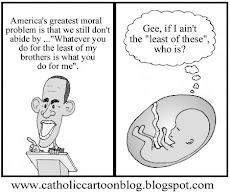

 Posts
Posts


