Note: This was the last post on my old blog, The Politics of the Cross, before I took it down. I'm re-posting it here because it fits with the thrust of this new/old blog.
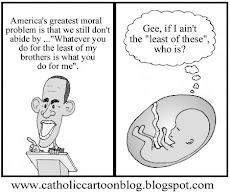
Halden has argued that I am wrong to say that the right to life cannot be reduced to being merely one issue among many. I'm concerned about the arguments he uses to reach this conclusion - much more so than the conclusion itself.
http://inhabitatiodei.wordpress.com/2008/09/15/moral-equivalence-war-and-abortion/#comments
Like the Catholic bishops who have responded to Pelosi's and Biden's misleading statements, I agree that to vote for a pro-abortion politican when a choice exists to vote for a pro-life one, is to cooperate in a grave moral evil and to cut oneself off from the church. This is because, while many other issues involve prudential judgments, abortion is always the taking of an innocent human life and is therefore always intrinsically evil.
To commit a grave moral evil knowingly is to sin in a "high-handed" manner, as the book of Leviticus puts it, and is distinguished from sinning by omission or without being conscious of what one is doing. (This is related to the difference between venial and mortal sin.) Both kinds of sin (high-handed and unintentional) incur guilt, but the sacrificial system makes clear that they have different moral standing in God's eyes and are therefore treated differently in terms of the kind of sacrifice (and the kind of restitution) required. The distinction between murder and manslaughter is embeded in the Torah and the punishments for them are different. Capital punishment and war are also distinguished from murder in the Torah. Now you can say that the Torah is fulfilled in Jesus, but as Paul argued to his Jewish critics, this is not the same as saying that the Torah is simply abolished. To follow and obey Jesus is not to lose the ability to make moral distinctions between different kinds of sin; in fact the Torah continues to instruct Christians in such matters.
Halden thinks all killing is morally equivalent and that the kinds of distinctions between, say manslaughter and first degree murder, do not exist. So the Polish soldier fighting the Nazi invasion of Poland in 1939, the Nazi death camp guard killing Jewish men, women and children for being Jewish, the state executing a mass murderer, a policeman shooting a gunman who has been killing students in a high school and a doctor injecting poison into the veins of a mother so the son can inherit her estate are all morally equivalent. He denies that there is any difference between killing the innocent and killing the guilty, so far as incurring guilt is concerned (though he admits we have a different emotional reaction to them).
He seeks to ground this is the doctrine of atonement and says that because God gave His life for sinners, that proves there is no real distinction between the innocent and the guilty. But if that were true, I fail to see why God should have to become incarnate and die on the cross to redeem the world. If there actually is no distinction betwen the innocent and the guilty, why not just declare everyone saved and skip the cross? It seems to me that to deny any moral distinction between the innocent and the guilty is to deny the whole concept of lost and guilty sinners needing redemption because they have broken God's law and are deserving of nothing but death.
In the course of thinking about a lecture I'm to give next Spring "A Critique of the Liberal Reading of Yoder" I have been wrestling with what it means to subscribe to "pacifism." Perhaps, to sharpen the question, we should speak of "theoretical pacifism" as opposed to "practical pacifism." It is well known that Karl Barth, in CD III/4 on the ethics of war, claimed that he could not affirm pacifism per se but must leave room for the Grenzfall, the borderline exception in which it might be possible to hear the command of God to go to war. However, he called himself a "practical pacifist," and condemned most war including all nuclear war. I define "practical pacifism" as Barth's position, as over against "theoretical pacifism," which says no to all killing with an absolute certainty that permits pacifism to become a principle that can be used to shape and critique everything else.
Yoder was disappointed in Barth's reluctance to go all the way to pacifism and called the Grenzfall a remnant of natural theology that is inconsistent with Barth's overall theology. Yoder wanted Barth to go further toward what I'm calling "theoretical pacifism," although it is far from clear to me that he wanted what I have just defined as "theoretical pacifism." Certainly people like J. Denny Weaver adamantly claim that he did, but I think that there is considerable ambiguity in Yoder's position.
Yoder recognized that, for Barth, the Grenzfall is not an escape hatch introduced when things get tight, but rather, a "solid principle," and "a rule that there must be an exception to every rule" and even "a theological necessity." And Yoder did affirm that he could accept one possible interpretation of the Grenzfall. He wrote:"Still another way of understanding the 'extreme case' would be to say that human knowledge is finite and that all human statements are open to correction because there might still be further facts to be discovered or further truths to be revealed. Therefore any statement which we make, and this would apply to doctrine as well as ethics, is made 'subject to further notice.' This is certainly a very defensible argument." (Karl Barth and the Problem of War, 52)
As Yoder points out, the Grenzfall does not guarantee that we will ever find an exception to the command to nonviolence any more than we can guarantee that we will not. It can simply function as a reminder and a marker of the limits of human knowledge. So far as we know right now, we will never encounter a situation in which the norm of nonviolence should be abandoned. But we leave open the possibility. (This also allows us to see such exceptions having been made in cases in the Old Testament, such as in the extermination of the Canaanites.) For Yoder, accepting the Grenzfall did not necessarily mean abandoning practical pacifism. Yoder clearly was more comfortable not using the concept. But Yoder was not able to convince Barth to drop the concept; they disagreed on the relevance of the Grenzfall for Christian ethics. Barth would not call himself a "pacifist" (his term) meaning a "theoretical pacifist" (my term), even though he would go so far as to call himself a "practical pacifist" and say that pacifism has almost infinitely strong arguments on its side. My interpretation of this dispute is that Barth remained an Augustinian for what I consider to be very good reasons, whereas Yoder never really came to grips with Augustine. For Yoder, the Grenzfall really functioned in Barth's theology as a remnant of natural theology. For Barth, it functioned as a barrier between church dogmatics and systematic theology.
I think that Yoder could have accepted Barth's interpretation of the Grenzfall and that it would have strengthened, not weakened, his pacifism. But to argue that he could have is not to forget that he didn't do so. So I see Yoder as ambigious at this point. I don't think Yoder was a "theoretical pacifist," but I think that there is enough ambiguity in his work to argue both ways. My main point is not to argue that Yoder can't be interpreted as a "theoretical pacifist," but to argue that he need not be interpreted that way and that we should not either interpret Yoder that way or take that view ourselves.
Barth rejected all systematic theology because he held that the human mind cannot capture the truth about God in a human intellectual system. Since the mystery of God in Jesus Christ cannot be fully grasped by the human mind, we must approach this mystery from different angles using the various dogmas and each one will give us a unique and partial yet true insight into God. Each volume of the CD starts again from the beginning to speak of God from yet another angle. In this approach, Barth was Augustinian. Augstine once said: "If you can comprehend it, it isn't God."
I think that Barth was right and Yoder was wrong on this issue of the usefulness of the Grenzfall as a concept in Christian ethics. Why? For two main reasons:
1. God being a God of love does not preclude the fact that God is also a God of judgment. This is a moral universe and good will be rewarded and evil will be punished. If it were not for the resurrection, judgment, reward and punishment, then there would be no answer to the problem of evil. We know that we will judge angels. (I Cor. 6:3) We don't know what this means, but it is a reminder that the saints have some sort of role in the eschatological judgment by which evil will be dealt with and the New Heavens and New Earth come into being. Since there is often a triumph of injustice in this life, we better hope that there is a Day of Judgment and a settling of accounts by a perfectly just and righteous Judge. God used Israel to judge pagan nations in Canaan in the Old Testament and we are told that we will judge angels in the New Testament. We would not expect to receive a command to engage in judgment and punishment in this age, but would be going too far to eliminate totally the possiblility in theory.
2. If "theoretical pacifism"becomes a principle (an "ism") then it can easily turn into an organizing principle for a systematic theology. This happens in certain liberal readings of Yoder, as for example in Denny Weaver's The Nonviolent Atonement. Non-violence or pacifism becomes the central organizing principle and is used to re-interpret Christology, the doctrine of the atonement, the doctrine of final judgment, the doctrine of sin and, finally, the doctrine of God. (This is similar to the way the doctrine of double predestination comes to distort post-Reformation Reformed theology. A rationally clear principle is taken as the center piece and via deductive logic all the other loci are re-interpreted in such a way as to produce a logical system.) Ironically, in the case of Weaver, this is done all the while loudly protesting against the systematic theology of Christendom as inherently totalizing and violent! When Anabaptist theology becomes liberal, it becomes rationalistic even while purportedly rejecting systematic theology.
Conclusion
The assertion that there is moral equivalence between killing in war, capital punishment, the killing of a criminal by a policeman who is protecting innocent people, abortion and ethanasia is a sign that something has gone wrong in theology. When all forms of taking human life are said to be morally equivalent, it is a sign that nonviolence has turned into a rational principle that trumps everything else. Degrees of innocence and guilt are irrelevant because there is actually only one real moral principle left: nonviolence. You either are nonviolent or you aren't - end of discussion.
The principle of nonviolence then becomes a criteria by which all other doctrines are judged and refined. Sin, judgment, Christology, atonement and eschatology are all understood in a novel manner.The final outcome is that God comes to be defined as nonviolence. This reduces God to a rationally comprehensible principle that, once it is known by us can be used as a magic key to unlock every door. The end result is the worship of an idol created by us in our image according to an interpretation of Jesus that is not the result of exegeting the Scriptures as a whole, but rather is the result of importing a rational principle that makes sense to us into the biblical accounts of Jesus and then used as a hermeneutical key to bring the Bible as a whole into line with this principle.
I conclude therefore that, so far as I can see, a disciple of Jesus can be a "practical pacifist" but not a "theoretical pacifist" because practical pacifism involves following a Lord on a path of discipleship in such a way that we cannot know the future, but have to trust him to lead and guide us when we get there, whereas theoretical pacifism involves coming to know a rational principle that make discipleship possible without the Lord because we already know the answer to all the questions ahead of time.
Showing posts with label Karl Barth. Show all posts
Showing posts with label Karl Barth. Show all posts
Friday, September 26, 2008

Thursday, September 25, 2008
The Cross as Judgment
In the two quotes on the heading of this blog, we see St. Augustine expressing the common faith of the early church in the doctrine of Divine judgment. The end of the second article of the Apostles' Creed says: "He ascended into heaven and sits at the right hand of God the Father Almighty, whence He shall come to judge the living and the dead."
In the first quote, St. Augustine sees the cross as a judgment seat from which Christ begins (and foreshadows) his work of dividing the sheep and the goats to his right and and to his left respectively. In the second, St. Augustine speaks of the future bodily second coming of Christ when he will judge all men in human form. In the same passage just prior to this quote, St. Augustine notes that, even though the Father will judge, He will judge by the coming of the Son and quotes John 5:22, which says that the Father "Judges no one, but has committed all judgment to the Son."
In modern, liberal interpretations of the cross I note that quite often the element of judgment is muted or elided. The current debate within Evangelical circles arising from the attempts of some to dismiss the penal substitutionary theory of the atonement as sub-Christian is a sign that liberal theology is becoming more congenial to some Evangelicals than it used to be. I do not think that the atonement can be reduced to nothing but the penal substitutionary theory, as if the Christus Victor and exemplarist theories were unimportant to a full-orbed understanding of the meaning of Christ's death. I do, in fact, see something true in all the major theories of the atonement. But I do not think that one can simply throw out the idea of Christ bearing our sins as our atoning sacrifice and the wrath of God falling on Him instead of on us and still do justice to the New Testament as a whole. Christ is the "Judge Judged in Our Place" as Barth famously put it. (CD IV/1, 211).
When I wrote The Politics of the Cross: the Theology and Social Ethics of John Howard Yoder, I did not interpret Yoder as denying the fact of God's judgment of sin either on the cross or in the future, although many others do interpret Yoder in such a way as to make God completely passive in simply bearing sin Himself, but not judging sin actively, and in suffering the wrath of the powers but not being wrathful against "the godlessness and wickedness of men." (Rom. 1:18) The suffering love God endured in the person of the God-Man on the cross is sometimes seen as the sum and substance of God's redemptive action in history and as the model for us to adopt as nonviolent followers of Jesus.
But I cannot accept a definition of Christian love as essentially, or exclusively, passive suffering; I think it is necessary to see God's love as active judgment as well as passive suffering. In the cross we are confronted with a mystery of Divine love and Divine wrath coming together in such a way that God bears the sins of the world in Himself, that is, in the person of the God-Man. Modern liberal theology takes the tension out of this mystery and resolves the meaning of the cross into a rationally comprehensible principle of nonviolence. Many theologians in the Anabaptist tradition see this liberal emphasis as a logical expression of their theological tradition. I do not.
As a Baptist, I have one foot in the Anabaptist tradition and the other in the Puritan wing of the Anglican Church out of which the English Baptists came. So perhaps it is not up to me to say what the logical culmination of the continental Anabaptist tradition is or is not. But let me say this quite clearly: if the logical development of the Anabaptist tradition is the bland theology of inclusion and acceptance as currently taught in liberal Protestantism, then I cannot recognize that tradition as my own. And if I am wrong about the proper interpretation of John Howard Yoder's thought (as I may well be, after all,) then I cannot recognize the Anabaptist/Liberal Yoder as a good teacher or myself as his follower.
This is why I have posted these quotes from St. Augustine on the header of this blog. I believe in a christologically-determined politics, a politics of the cross, but I do not believe that such a politics is mere passivity and the avoidance of violence through the adoption of a posture of withdrawal from the world. I don't believe Yoder reduced Chrisitian social witness to mere passivity and the avoidance of violence either; though that is a debate that is on-going. But the kind of christological politics (or politics of the cross) that I think is faithful to the complete biblical revelation of Jesus Christ and the tradition of the Church catholic is a politics that recognizes that in the cross God was in Christ both saving and judging the world simultaneously. And the mission of the Church involves bearing a witness to both of these aspects of the cross. Preaching Jesus is not the same thing as preaching Ghandi.
In the first quote, St. Augustine sees the cross as a judgment seat from which Christ begins (and foreshadows) his work of dividing the sheep and the goats to his right and and to his left respectively. In the second, St. Augustine speaks of the future bodily second coming of Christ when he will judge all men in human form. In the same passage just prior to this quote, St. Augustine notes that, even though the Father will judge, He will judge by the coming of the Son and quotes John 5:22, which says that the Father "Judges no one, but has committed all judgment to the Son."
In modern, liberal interpretations of the cross I note that quite often the element of judgment is muted or elided. The current debate within Evangelical circles arising from the attempts of some to dismiss the penal substitutionary theory of the atonement as sub-Christian is a sign that liberal theology is becoming more congenial to some Evangelicals than it used to be. I do not think that the atonement can be reduced to nothing but the penal substitutionary theory, as if the Christus Victor and exemplarist theories were unimportant to a full-orbed understanding of the meaning of Christ's death. I do, in fact, see something true in all the major theories of the atonement. But I do not think that one can simply throw out the idea of Christ bearing our sins as our atoning sacrifice and the wrath of God falling on Him instead of on us and still do justice to the New Testament as a whole. Christ is the "Judge Judged in Our Place" as Barth famously put it. (CD IV/1, 211).
When I wrote The Politics of the Cross: the Theology and Social Ethics of John Howard Yoder, I did not interpret Yoder as denying the fact of God's judgment of sin either on the cross or in the future, although many others do interpret Yoder in such a way as to make God completely passive in simply bearing sin Himself, but not judging sin actively, and in suffering the wrath of the powers but not being wrathful against "the godlessness and wickedness of men." (Rom. 1:18) The suffering love God endured in the person of the God-Man on the cross is sometimes seen as the sum and substance of God's redemptive action in history and as the model for us to adopt as nonviolent followers of Jesus.
But I cannot accept a definition of Christian love as essentially, or exclusively, passive suffering; I think it is necessary to see God's love as active judgment as well as passive suffering. In the cross we are confronted with a mystery of Divine love and Divine wrath coming together in such a way that God bears the sins of the world in Himself, that is, in the person of the God-Man. Modern liberal theology takes the tension out of this mystery and resolves the meaning of the cross into a rationally comprehensible principle of nonviolence. Many theologians in the Anabaptist tradition see this liberal emphasis as a logical expression of their theological tradition. I do not.
As a Baptist, I have one foot in the Anabaptist tradition and the other in the Puritan wing of the Anglican Church out of which the English Baptists came. So perhaps it is not up to me to say what the logical culmination of the continental Anabaptist tradition is or is not. But let me say this quite clearly: if the logical development of the Anabaptist tradition is the bland theology of inclusion and acceptance as currently taught in liberal Protestantism, then I cannot recognize that tradition as my own. And if I am wrong about the proper interpretation of John Howard Yoder's thought (as I may well be, after all,) then I cannot recognize the Anabaptist/Liberal Yoder as a good teacher or myself as his follower.
This is why I have posted these quotes from St. Augustine on the header of this blog. I believe in a christologically-determined politics, a politics of the cross, but I do not believe that such a politics is mere passivity and the avoidance of violence through the adoption of a posture of withdrawal from the world. I don't believe Yoder reduced Chrisitian social witness to mere passivity and the avoidance of violence either; though that is a debate that is on-going. But the kind of christological politics (or politics of the cross) that I think is faithful to the complete biblical revelation of Jesus Christ and the tradition of the Church catholic is a politics that recognizes that in the cross God was in Christ both saving and judging the world simultaneously. And the mission of the Church involves bearing a witness to both of these aspects of the cross. Preaching Jesus is not the same thing as preaching Ghandi.
Subscribe to:
Posts (Atom)





 Posts
Posts


