No, Ron Paul is a libertarian and that is why I utterly despise his political philosophy and regard it as being as great a danger as socialism. Libertarianism is incompatible with conservatism and incompatible with Christianity.
Many people are confused by Ron Paul's clever hijacking of the Republican Party's presidential nomination process to use as a platform for his nefarious ideas, but Ron Paul is no conservative and it is important for every Christian to understand the difference between what he stands for and what true conservatism is all about. I believe that a Biblical Christian must be a conservative of some sort and cannot be a consistent socialist or libertarian without compromising the Faith. But definitions are essential for understanding. But these terms need definition or my statements will be misunderstood.
William D. Gairdner has the best brief explanation of the difference between socialism, conservatism and libertarianism in his book, The Trouble with Canada. . . Still! (Chapter 6) Here is how he explains it.
Think of our society as having three layers. At the top is the State, the governing power. At the bottom are individuals considered as individuals only. In the middle layer are a multitude of intermediate institutions and structures which are collectively called "civil society." These range from the relatively shallow and ephemeral ones such as bowling leagues and gardening societies to the family, which is pre-political, universal and rooted in nature not culture. The Church is also part of civil society and both Church and Family are prior to the State, which is to say that the State can only recognize their integrity and right to exist but has no power to alter, ban or attack them. Historically and logically (and ontologically) the Church and Family precede the State.
Socialism:
Now, we can define our terms. Socialism is a form of statism, which means that socialists believe that society should be governed from the top down by an elite class of scientific planners with the chief goal being equality of outcome so that everyone has roughly the same income no matter how talented or hard-working each one is. This belief is what makes socialism a form of "statism" and all forms of statism are bad including absolute monarchies, communism, fascism and big-government, welfare-state liberalism. The idea that government should be a rational, top-down operation is the essence of the problem and this idea comes out of the Enlightment. All the various forms of statism are variations on a theme; all are oligarchic in nature.
Libertarianism:
Libertarianism is the exact opposite of statism and statism's sworn enemy. Libertarians focus on the individual and ignore the middle layer of civil society.
Because of the state's monopoly on violence, libertarians have to acknowledge the existence (and grudgingly even the limited legitimacy) of the state. But their ideal is to limit the state as much as possible, keep taxes low and provide individuals with as much liberty as possible. The only justification for the state making and enforcing a law is to protect one person from harming another. But anything that does not harm someone else should be legal. This is why Ron Paul is in favor of legalizing drugs, for example. The argument that weak people will get addicted and be exploited by drug pushers makes cuts no ice with libertarians. Their attitude is a Nietzchean indifference: "Too bad for gullible idiots."
Conservatism:
Conservatives are different from both of the above two political philosophies in that conservatives do not have an ideology. Conservatives do not make either individual liberty or equality the first principle from which all political decisions flow, as do libertarians and socialists respectively. Conservatives do not believe in top down or bottom up governance, but instead focus on the preservation and nurturing of civil society. Conservatives believe that manners and customs are important and that law should evolve slowly up from thousands of individual court decisions. Therefore, conservatives support English common law rather than French-style code law.
Conservatives believe that a Hobbsian war of all against all, such as libertarianism would foster, is extremely bad, but they also believe that the statist cure of Nanny Government riding to the rescue at the expense of personal freedom is a cure worse than the disease. (This last point explains why, despite their disagreements, conservatives and libertarians can make a tactical alliance against all forms of statism.)
But conservatives believe that it is Family, Church and other forms of local community that give life meaning rather than individualism or collectivism (two modern ideologies). Conservatives believe that we need a state, but that it is severely limited in what it can accomplish. Most of what the state legitimately does is negative: punishing crime, defending the borders etc. But the postive shaping of virtue and individual lives should not be done by the state, but by civil society, primarily the Family and the Church. The reason for this view is that conservatives believe that morality and the meaning of life is not determined by the State.
Conservatives believe in a transcendent moral order (whether conceptualized as Divine commands, natural law or Tradition) that must be recognized. All religions and even virtuous irreligious people agree on basic morality (what C. S. Lewis in The Abolition of Man terms the Tao.) This means that conservatives accept limits to Utopian efforts to make the world perfect and also limits on personal freedom.
In fact, for conservatives real freedom is not the ability to enact one's whims or satisfy one's appetites at every moment; real freedom is the ability to realize our telos, to achieve our purpose as human beings. Christians believe we have both a natural telos as humans and an ultimate telos consisting of the beatific vision. In other words, we were made by God and for God. But we discover our true nature as human beings not as members of the mass society governed by statist planners or as individuals choosing our own values, but through religion, family and community.
Liberalism:
There is one more term whose meaning is very difficult to pin down and which causes a lot of confusion. That term is, of course, "liberalism." What is liberalism?
Classical 19th century liberalism was a political philosophy that emphasized limited government, free markets and individual liberty with a recognition of Christianity as true and as the source of parliamentary democracy, human rights and political liberalism. This political philosophy, which has influenced much of the world through the influence of the British Empire, has been the greatest means of gaining freedom, prosperity and justice for whole societies that the world has ever seen.
The problem is that in the 19th century Europe lost its faith in Jesus Christ, as did a large chunk of the governing elites in the US, Canada and the rest of the West. This loss of faith, known as "secularization," has removed the foundation of political liberalism and has caused political liberalism to decay and rot.
During the 20th century one strand of liberalism decayed into libertarianism. With nothing more solid than the conceptually incoherent utilitarianism of J. S. Mill to sustain it, this kind of liberalism without God glorified "choice" and "the individual" until it could not avoid falling into the Nietzschean glorification of the "will to power." This is the philosophical basis of the "right to choose" slogan of the abortion wars.
In the 20th century another strand of classical liberalism decayed into pseudo-socialism. These liberals lost their grip on a transcendent concept of justice (natural law) and fell into epistemological and ethical relativism. Multiculturalism and socialist attempts at re-distribution of wealth by the state were policy results.
One strand of liberalism made an idol out of "choice" and the other made an idol out of "equality" and then eventually these two strands came together in what we can call "libertarian socialism." This is a political philosophy in which the sexual revolution meets Karl Marx with the result that contraception, pornography, promiscuity, divorce, abortion, homosexuality etc. create the illusion of "freedom" for the individual while the state confiscates an ever-increasing percentage of his income in taxes and creates an endlessly-increasing number of regulations, legal requirements and administrative laws take the place of the morality taught by the Church and inculcated by the Family.
Statists don't believe that "Father knows best" but rather that "Government knows best." And they have the nerve to mock those of us who think a flesh-and-blood father relating personally to his blood relations is dispensable while government bureaucrats performing impersonal social engineering on us is perfectly normal!
Classical liberalism is a good thing. But the word has been corrupted by those who like to hide behind it while acting as libertarian socialists. If Obama is a "liberal" then the word has lost its value. The irony is that the only people who stand today for real liberalism are conservatives.
One last point is important. I believe that a Christian must be a conservative in our historical situation because Christianity has shaped Western civilization in such beneficial and life-giving ways: limited government, parliamentary democracy, free markets, the rule of law, free speech, religious freedom, the public recognition of God, the natural law as the basis of positive law, the common law system and so on. European culture has been shaped by the uniquely Christian doctrine of the division of powers reflected in the separation of church and state. This is not a doctrine of the marginalization or privatization of church as in secularism, but a doctrine that says that both church and state have valid, though different, roles to play is sustaining a liberal democracy.
The key points to recognize are (1) that liberal democracy does not work without Christianity and (2) that Christianity must be mediated to society through civil society. Therefore a secularized liberal democracy will always degenerate into the individualistic chaos of libertarianism or the suffocating bureaucracy of statism. As Yeats put it "The center does not hold."
This is why libertarianism is so bad. Ron Paul may be a Christian; I don't know. But libertarianism is pernicious. It is what you get when you take individual liberty to such an extreme that you eliminate the structures of civil society that make society civilized.
Cross-posted at The Bayview Review.
Showing posts with label Libertarianism. Show all posts
Showing posts with label Libertarianism. Show all posts
Sunday, January 8, 2012

Monday, December 19, 2011
Is There Too Much Government in Our Lives?
If you are interested in a civil, extended debate on the issue of how big government should be between articulate representatives of both the Left and the Right today, you should check out this 40 minute debate between George Will and Paul Ryan, for the Right, and Barney Frank and Robert Reich, for the Left, moderated by Christiane Amanpour of ABC.
I thought that Ryan and Will were good, but not able to articulate some key points that would have enabled them to put the real issues on the table. Barney Frank is a good debater (a true Sophist) and was able to frame the debate in such a way as to disguise his support for big government control of the lives of ordinary people. For him, citizens are reduced to clients of government. Yet, by harping on conservative support for basic sexual morality, he was able to portray liberals as the libertarians. This is a major point on which people generally are confused today.
If you want to get to the section on individual liberties, go to the third segment. About a third of the way in or so, Frank starts ranting about anti-drug laws, marriage laws etc. and puts the conservatives on the defensive as defenders of intrusive "big government," which clearly makes them very uncomfortable.
You can check out the debate here.
What Will and Ryan Should Have Said
Will and Ryan missed the chance to say something like this to Frank after his big rant about how libertarian the socialists like him are:
I thought that Ryan and Will were good, but not able to articulate some key points that would have enabled them to put the real issues on the table. Barney Frank is a good debater (a true Sophist) and was able to frame the debate in such a way as to disguise his support for big government control of the lives of ordinary people. For him, citizens are reduced to clients of government. Yet, by harping on conservative support for basic sexual morality, he was able to portray liberals as the libertarians. This is a major point on which people generally are confused today.
If you want to get to the section on individual liberties, go to the third segment. About a third of the way in or so, Frank starts ranting about anti-drug laws, marriage laws etc. and puts the conservatives on the defensive as defenders of intrusive "big government," which clearly makes them very uncomfortable.
You can check out the debate here.
What Will and Ryan Should Have Said
Will and Ryan missed the chance to say something like this to Frank after his big rant about how libertarian the socialists like him are:
"What you are doing is expressing the new view of liberals, which is "Libertarian Socialism." The classical liberalism of the 19th century depended on Christianity to uphold a social consensus on personal morality, which allowed for the extension of liberty in more and more areas of life. Anarchy and social breakdown was prevented by the existence of church and family and the morality inculcated through these institutions. But now, contemporary liberals have broken with Christianity and its traditional support for the defense of human life, traditional marriage and the family and have thrown in their lot with the cultural Marxism that seeks to destroy private property, the family and the church as obstacles to the Socialist Revolution. So an alliance has arisen between individual libertarianism in matters deemed private - sex, drugs, the family, etc. - and intrusive, big-government socialism in all matters deemed public - money, taxes, education, the military, etc.. This is a new phenomenon in the second half of the 20th century to the present: Libertarian Socialism.Contemporary liberalism does not deserve to be called "Liberalism" because it is not about liberty any more; it is a movement designed to destroy liberty. This is what Ryan and Will should have said.
What Libertarian Socialism does is to provide cover for the collectivists who want a ruling class of "experts" to have totalitarian control over the lives of everyone else. It does so by creating the illusion of freedom. When people are told they can have as much sex as they want with whomever they want any time they want, they can fall into the trap of believing they are, therefore, free. But this is not true freedom. It is a lie. It is an illusion of freedom, a parody of true freedom. True freedom is the ability to achieve one's telos, the end for which one was created. It is to become what one was created with the potential to become. Just as the telos of an acorn is to grow into a mighty oak tree, so the telos of the human being is to grow into a mature, responsible, moral agent who consistently chooses what is objectively good instead of being distracted into making choices that prevent one from attaining the good.
Libertarian Socialism prevents humans from becoming fully human in two ways. It infantilizes people and it removes their ability to make moral choices. It infantilizes them by assuming that the government take care of them. So we have socialized medicine in Canada, socialized education, government welfare cheques to replace fathers in the home and so on. Socialism creates a permanent, dependent class of clients who gradually lose the ability to govern themselves and, as that happens, they become happy to be governed from above. A good example of this is the massive intrusion of "family court judges" into the minute details of the lives of families down to determining their daily and weekly schedules as a result of granting the so-called "freedom to divorce easily." This is freedom? It looks more like a government take-over of the family.
Libertarian Socialism removes the ability of people to make good moral choices in two ways. First, it encourages them to make bad choices. Today government makes money out of encouraging gambling, drunkenness, pornography and, soon, prostitution. Libertarian Socialism professes to regard the individual freedom to commit consequence-free adultery as sacrosanct, but thinks it is only right to take money away from the middle-class tax payer to give to its cronies in socially-approved industries such as wind power.
If the goal of socialists is to have a ruling class of "experts" control every aspect of life in order to create a Utopian society free of poverty, crime and inequality, then libertarianism in the area of personal sexual morality is a double benefit to their cause. For one thing, it breaks down personal responsibility and encourages people to simply give in to their appetites, which makes them dependent clients without the personal discipline to demand freedom in other areas. For another, it destroys the family, which is the main bulwark against the tyranny of the total state.
The real agenda of Libertarian Socialism is not individual freedom at all, but rather a government so big, so intrusive, so controlling and so pervasive that individual freedom is destroyed forever. The logical and inevitable outcome of Libertarian Socialism is portrayed in Aldous Huxley's prophetic novel: Brave New World. In this horrifying portrait of the society of the future, our humanity has been all but erased and people are but children, wards of the state. The family has been abolished, promiscuity is a social duty and drug-taking is a way of life for all." In pursuit of Utopia, our basic humanity is diminished and our status as responsible moral agents is destroyed. Libertarian Socialists ought to understand that in the long run the Socialism will swallow up whatever libertarian ideas are embraced today.
Friday, December 3, 2010
Ron Paul Jumps the Shark
Ron Paul has officially crossed the border between Reality and Insanity by coming out in support of Julian Assange's release of government secrets designed to hurt the United States of America and its capacity to keep its citizens safe and conduct diplomacy. Assange is acting out a technological version of the anarchists who travel the world to break windows and set cars on fire every time the G-20 meets.
Politico reports:
Ron Paul is a libertarian and here he crosses the last boundary marker separating him from anarchy and the far left. It is time to shut down Julian Assange and launch an investigation into his connections to George Soros. We would all be better off with both of them out of commission.
Politico reports:
How can he say that truth can never be treason? Does he think that trading nuclear secrets to the Soviets in the 1940s would not be treason just because the revealed information was true? It is OK for people to tell America's enemies all about America's plans to foil terrorist plots just because those plans are true? Actually, it has to be true in order for it to be treason!
Ron Paul is a libertarian and here he crosses the last boundary marker separating him from anarchy and the far left. It is time to shut down Julian Assange and launch an investigation into his connections to George Soros. We would all be better off with both of them out of commission.
Monday, July 5, 2010
Atlas Shrugged: A Brief Review
Ayn Rand's famous novel Atlas Shrugged, written over 50 years ago, is currently sitting at 977th place on Amazon.com. That is a pretty amazing fact, when you think about it. The ideas of Ann Rand are incredibly influential today within the conservative movement in America and show no sign of evaporating despite the studied indifference projected by the academic, journalistic and political elites.
This was my first direct exposure to the secular libertarianism of Ann Rand and, while she represents a strand of the conservative coalition that is very different from my traditional, religious and social conservative beliefs strand, it is important to see in what sense she could be considered a co-belligerent in the war against collectivism.
First, let me say something about the merits of the novel from the point of view of art. I found the novel poorly written and the characters shallowly portrayed. The portrayal of the developing crisis is out of focus with too much time spent on a few characters making philosophical speeches and not enough time examining the actual process of social breakdown and disintegration. It seems that there is only enough of a plot to serve as a backdrop for the philosophical exchanges between the characters. But in fairness, that could be said of Plato's dialogues as well - although they are incomparably better written.
Second, let me say what I appreciated about the book. I found the portrayal of the philosophy of the "looters" (i.e. the socialist government and its admirers) to be bitterly accurate and telling. She has those guys nailed and this, I suspect, is the real motive power of the book. This is what makes her positive philosophy credible: that she understands her opponents more profoundly than they understand themselves. She describes the slogans, the rhetoric, the tricks, the manipulation, the jargon and the self-deception of those who use high sounding ideals to cover over their selfish pursuit of power and are so convincing that they even fool themselves.
Third, I turn to what I disagreed with in the book. Rand is a throwback to the Enlightenment Philosophes and it seems that, for her, the 18th century has never ended. (I don't begrudge anyone their favorite century; mine is the 13th. And I share her revulsion toward the ugly, violent, squalid 20th century.) But Rand does not seem to know that the Enlightenment is over.
The Medieval Synthesis of Aristotelianism and Augustinianism and the Enlightenment attempt to exalt Autonomous Reason without God both have in common a love and respect for the power and reality of human reason. Both believe in truth and logic. Both reject pragmatism, relativism and ideology. Augustinian Thomism and the Enlightenment are united in the rejection of superstition and the right of brute force to rule the mind and both have a deep respect for the individual human being and profound antipathy toward the rule of power that is not grounded in law.
Nevertheless, Thomism and the Enlightenment represent two great mutually exclusive alternatives philosophies of life. One grounds reason in the Logos of Creation and the other rests it on thin air (Chance). Rand does not acknowledge that the swirling universe of atoms in random motion coming together by chance could never produce consciousness, morality or natural law. The Personal cannot arise out of the Impersonal and to assert that it does is to invite skepticism as to whether one really believes in Personality at all. She shares the eager faith of the 18th century that Reason can be its own foundation, that science can rest safely and securely on nothing but itself. She refuses to recognize that the contemporary irrationality and socialist ideology, which dominates Western elite culture, is a degenerate child of the Enlightenment rejection of God and proud assertion of individual autonomy.
The faith in Reason of the Enlightenment gave way to the faith in Feeling in the 19th century Romantic reaction to the Age of Reason and then degenerated into the worship of the will prophesied by Nietzsche and acted out in the brutal 20th century - the century of genocide and mass murder. She has no sense of the internal contradictions of freedom that rests not on natural law written on creation by the Designer of that creation, but only on what individual men choose to recognize as law. She does not see that a world without design imposed on it from the outside is a world that can have meaning only as strong-willed individuals impose a meaning on it by their own strength of will.
Perhaps, in the end, this is what secular libertarianism amounts to: a philosophy of life appropriate only for the Overman. This problematic relationship between will and reason is the elephant in the room throughout the book. She sees how the "looters" degenerate into subhumans as they follow nothing but their animal urges and inclinations of the moment. Yet, her heroes and heroines engage in sex whenever they feel like it and glorify the satisfaction of bodily urges outside any moral framework as the rejection of gnostism and the affirmation of the life impulse. Yet, she does not seem to see that gnosticism has a libertine form as well as an ascetic form. Her heroes are superior to the socialist looters only as the Nietzschean Overman is superior to the last men.
This defect in understanding apparently is rooted in the rejection of revelation and God's sovereignty. Like the 18th century Philosophes, she views religion as nothing but mysticism: the antithesis of reason. She claims that all other philosophies have divided man into a ghostly soul and an animal body and that only her philosophy holds him together in a unity. But she falls into the trap of the reason-revelation dualism and is like the man out of whom a demon was cast only to have seven demons worse than the first come to fill the void.
The void is that lack of a God in her philosophy. Man cannot be his own God and Reason cannot do the job either. This is what Rand cannot seem to admit. And so her worship of Reason ends in the rule by the will to power instead of by law. For Reason can only be a servant - it can serve either the will or the instincts - but it needs to serve something just as man was created to serve something - or Someone.
This was my first direct exposure to the secular libertarianism of Ann Rand and, while she represents a strand of the conservative coalition that is very different from my traditional, religious and social conservative beliefs strand, it is important to see in what sense she could be considered a co-belligerent in the war against collectivism.
First, let me say something about the merits of the novel from the point of view of art. I found the novel poorly written and the characters shallowly portrayed. The portrayal of the developing crisis is out of focus with too much time spent on a few characters making philosophical speeches and not enough time examining the actual process of social breakdown and disintegration. It seems that there is only enough of a plot to serve as a backdrop for the philosophical exchanges between the characters. But in fairness, that could be said of Plato's dialogues as well - although they are incomparably better written.
Second, let me say what I appreciated about the book. I found the portrayal of the philosophy of the "looters" (i.e. the socialist government and its admirers) to be bitterly accurate and telling. She has those guys nailed and this, I suspect, is the real motive power of the book. This is what makes her positive philosophy credible: that she understands her opponents more profoundly than they understand themselves. She describes the slogans, the rhetoric, the tricks, the manipulation, the jargon and the self-deception of those who use high sounding ideals to cover over their selfish pursuit of power and are so convincing that they even fool themselves.
Third, I turn to what I disagreed with in the book. Rand is a throwback to the Enlightenment Philosophes and it seems that, for her, the 18th century has never ended. (I don't begrudge anyone their favorite century; mine is the 13th. And I share her revulsion toward the ugly, violent, squalid 20th century.) But Rand does not seem to know that the Enlightenment is over.
The Medieval Synthesis of Aristotelianism and Augustinianism and the Enlightenment attempt to exalt Autonomous Reason without God both have in common a love and respect for the power and reality of human reason. Both believe in truth and logic. Both reject pragmatism, relativism and ideology. Augustinian Thomism and the Enlightenment are united in the rejection of superstition and the right of brute force to rule the mind and both have a deep respect for the individual human being and profound antipathy toward the rule of power that is not grounded in law.
Nevertheless, Thomism and the Enlightenment represent two great mutually exclusive alternatives philosophies of life. One grounds reason in the Logos of Creation and the other rests it on thin air (Chance). Rand does not acknowledge that the swirling universe of atoms in random motion coming together by chance could never produce consciousness, morality or natural law. The Personal cannot arise out of the Impersonal and to assert that it does is to invite skepticism as to whether one really believes in Personality at all. She shares the eager faith of the 18th century that Reason can be its own foundation, that science can rest safely and securely on nothing but itself. She refuses to recognize that the contemporary irrationality and socialist ideology, which dominates Western elite culture, is a degenerate child of the Enlightenment rejection of God and proud assertion of individual autonomy.
The faith in Reason of the Enlightenment gave way to the faith in Feeling in the 19th century Romantic reaction to the Age of Reason and then degenerated into the worship of the will prophesied by Nietzsche and acted out in the brutal 20th century - the century of genocide and mass murder. She has no sense of the internal contradictions of freedom that rests not on natural law written on creation by the Designer of that creation, but only on what individual men choose to recognize as law. She does not see that a world without design imposed on it from the outside is a world that can have meaning only as strong-willed individuals impose a meaning on it by their own strength of will.
Perhaps, in the end, this is what secular libertarianism amounts to: a philosophy of life appropriate only for the Overman. This problematic relationship between will and reason is the elephant in the room throughout the book. She sees how the "looters" degenerate into subhumans as they follow nothing but their animal urges and inclinations of the moment. Yet, her heroes and heroines engage in sex whenever they feel like it and glorify the satisfaction of bodily urges outside any moral framework as the rejection of gnostism and the affirmation of the life impulse. Yet, she does not seem to see that gnosticism has a libertine form as well as an ascetic form. Her heroes are superior to the socialist looters only as the Nietzschean Overman is superior to the last men.
This defect in understanding apparently is rooted in the rejection of revelation and God's sovereignty. Like the 18th century Philosophes, she views religion as nothing but mysticism: the antithesis of reason. She claims that all other philosophies have divided man into a ghostly soul and an animal body and that only her philosophy holds him together in a unity. But she falls into the trap of the reason-revelation dualism and is like the man out of whom a demon was cast only to have seven demons worse than the first come to fill the void.
The void is that lack of a God in her philosophy. Man cannot be his own God and Reason cannot do the job either. This is what Rand cannot seem to admit. And so her worship of Reason ends in the rule by the will to power instead of by law. For Reason can only be a servant - it can serve either the will or the instincts - but it needs to serve something just as man was created to serve something - or Someone.
Thursday, May 27, 2010
Jim Wallis Attacks the Tea Party: What are His Arguments?
Jim Wallis thinks Left-wing socialism is Christian but Tea Party libertarianism is not. He wants a debate. Fine, let's have it. I'm ready to debate Jim Wallis anytime. In what follows, I respond to his article. My emphases in bold and my comments are in [square brackets and red.]
Wallis sure has funny ideas about how to go about having a dialogue. But if you ask me, he would be better off hurling his rocks from a safe distance because he hasn't got much of an argument for his position."The insurgent Tea Party and its Libertarian philosophy is a political phenomenon, not a religious one. [OK, why is this relevant? Jim doesn't start off most of his articles by saying "Socialism (or Big Government Liberalism or the Welfare State) is a political phenomenon not a religious one. Maybe he should, unless he is trying to transform the Gospel into a political ideology. I think most Christians who support the Tea Party would agree that libertarian political philosophy is not the content of the Christian gospel but they would quite reasonably see Wallis's teachings as implying that Big Government liberalism, if not outright socialism, is the Christian gospel.] Like the Democratic and Republican parties it seeks to challenge, it is a secular movement, not a Christian one. As with both major political parties, people who regard themselves as Christians may be involved in, or sympathetic to, the new Tea Party; but that doesn’t make it “Christian.” [Just as Christian democratic socialist don't make democratic socialism "Christian."] But like the philosophies and policies of the major political parties, the Tea Party can legitimately be examined on the basis of Christian principles -- and it should be. [Agreed.]
Since the Tea Party is getting such national attention, our God’s Politics blog is going to begin a dialogue on this question: Just how Christian is the Tea Party Movement -- and the Libertarian political philosophy that lies behind it? Let me start the dialogue here. And please join in.
Libertarianism is a political philosophy that holds individual rights as its supreme value and considers government the major obstacle. It tends to be liberal on cultural and moral issues and conservative on fiscal, economic, and foreign policy. [This is true of some libertarians but not all by any means. Many economic libertarians are actually social conservatives on cultural and moral issues. Libertarianism is an older political philosophy than welfare state liberalism - not a recent "phenomenon" - and it has historically been just one co-belligerent in the conservative coalition in America along with traditional conservatives and social conservatives like me plus neoconservatives and foreign policy hawks. I would see libertarians as allies even though I am not one personally. I do think they are much less dangerous than the socialists in the Democratic coalition Wallis is part of. I'm happy to support smaller government in alliance with libertarians who support moral standards as on the pro-life issue for example.] This “just leave me alone and don’t spend my money” option is growing quickly in American life, as we have seen in the Tea Party movement. [It may be growing but the opposite philosophy currently controls the Presidency, both houses of Congress and at least half of the Supreme Court. So the "take-over" is not exactly imminent.] Libertarianism has been an undercurrent in the Republican Party for some time, [this is an attempt to paint it as less than mainstream despite it majority status among America voters] and has been in the news lately due to the primary election win of Rand Paul as the Republican candidate for a Senate seat in Kentucky. [Typical Democratic talking points - attack Rand Paul - but, will this work any better than the attacks on the Arizona immigration bill which are now backfiring with independent voters?]
. . . snip . . .
Is such a philosophy Christian? In several major aspects of biblical ethics, I would suggest that Libertarianism falls short.1. The Libertarian enshrinement of individual choice is not the pre-eminent Christian virtue. Emphasizing individual rights at the expense of others violates the common good, a central Christian teaching and tradition. [It is somewhat hypocritical to attack libertarians for emphasizing individual rights when you support a liberal philosophy that exalts individual choice on abortion, euthanasia, same-sex marriage, no-fault divorce and other issues concerning sexual ethics, family matters and the sanctity of human life. Why isn't Wallis attacking the "libertarianism" and "individualism" of the Left on these issues? When he sides with the social conservatives, THEN he will have the right to criticize the libertarians on individualism.] The Christian answer to the question “Are we our brother’s keeper?” is decidedly “Yes.” [Yes, but it is a huge leap to define that "we" as the State rather than us Christians or the Church.] Jesus tells us that the greatest commandment is to love God and love our neighbor. Loving your neighbor is a better Christian response than telling your neighbor to leave you alone. Both compassion and social justice are fundamental Christian commitments, [depends on what you mean by "social justice" here - if you are trying to smuggle in a commitment to socialism, that is not acceptable] and while the Christian community is responsible for living out both, government is also held accountable to the requirements of justice and mercy. Both Christians on the Right and the Left have raised questions about Libertarian abandonment of the most vulnerable — whether that means unborn lives or the poor. [As a pro-lifer, I'd rather take my chances with the Tea Partiers rather than with the supposedly compassionate Democratic Party!]
Just look at the biblical prophets in their condemnation of injustice to the poor, and how they frequently follow those statements by requiring the king (the government) to act justly (a requirement that applied both to the kings of Israel and to foreign potentates). Jeremiah, speaking of King Josiah, said, “He defended the cause of the poor and needy, and so all went well” (Jeremiah 22:16). Amos instructs the courts (the government) to “Hate evil, love good; maintain justice in the courts” (Amos 5:15). The prophets hold kings, rulers, judges, and employers accountable to the demands of justice and mercy. [Notice that there is nothing in these verses about socialism or the welfare state or redistribution of wealth. The prophets were talking about justice and the rule of law - major conservative principles. And they were critics of the advent of "big government" under the Kings.]
2. An anti-government ideology just isn’t biblical. In Romans 13, the apostle Paul (not the Kentucky Senate candidate) describes the role and vocation of government; in addition to the church, government also plays a role in God’s plan and purposes. Preserving the social order, punishing evil and rewarding good, and protecting the common good are all prescribed; we are even instructed to pay taxes for those purposes! Sorry, Tea Party. Of course, debating the size and role of government is always a fair and good discussion, and most of us would prefer smart and effective to “big” or “small” government. [It is not anti-government for libertarians to want government to stick to core functions of enforcing justice and national defense rather than intruding into every area of life and replacing the family as the main provider of income to most citizens. Libertarians are not anti-government; they just have a different view of its proper function than Wallis does.]
Revelation 13 depicts the state as a totalitarian beast — a metaphor for Rome, which was persecuting the Christians. This passage serves as a clear warning about the abuse of governmental power. But a power-hungry government is clearly an aberration [one wonders how much history Wallis reads when he throws out an over-generalization like that] and violation of the proper role of government in protecting its citizens and upholding the demands of fairness and justice. To disparage government per se — to see government as the central problem in society — is simply not a biblical position. [As Rom. 13 and Rev. 13 demonstrate, government can be either a servant of the people or an out-of-control monster and the bigger the government is the more of a danger it is. Libertarians don't disagree with that.]
3. The Libertarians’ supreme confidence in the market is not consistent with a biblical view of human nature and sin. [I'm glad Wallis has rediscovered the doctrine of sin all of a sudden! But . . . the Big Government Liberal's supreme confidence in the State is not consistent with a biblical view of human nature and sin.] The exclusive focus on government as the central problem ignores the problems of other social sectors, and in particular, the market. [The typical Big Government liberal exclusive focus on the market as the problem ignores the problems of other sectors, and in particular, the State.] When government regulation is the enemy, the market is set free to pursue its own self-interest [the market does not have an "interest" because it is not a person - any more than a government office has an interest without someone filling that office who does have "interests." A market is a democratic mechanism for setting prices as opposed to prices being set arbitrarily by bureaucrats on the basis of central planning] without regard for public safety, the common good, and the protection of the environment — which Christians regard as God’s creation. Libertarians seem to believe in the myth of the sinless market [again, it is not the market that is sinful and to demonize the only economic system in the world to have lifted the majority of the population out of poverty like this is just irresponsible Marxist propaganda] and that the self-interest of business owners or corporations will serve the interests of society; and if they don’t, it’s not government’s role to correct it. [This places all power in the hands of the State. Apparently the Christian view of human nature and sin don't apply to anyone who gets elected or hired as a government bureaucrat. There is a difference between the proper role of government: to ensure the rule of law and uphold justice and the falsely expanded role of government to replace the market and ensure equality of outcomes.]
But such theorizing ignores the practical issues that the public sector has to solve. Should big oil companies like BP simply be allowed to spew oil into the ocean? [No libertarian I've ever met has ever said yes to that -a straw man argument coupled with an appeal to emotion.] And is regulating them really un-American? Do we really want nobody to inspect our meat, make sure our kids’ toys are safe, or police the polluters to keep our air clean? Do we really want owners of restaurants and hotels to be able to decide whom they will or won’t serve, or should liquor store owners also be able to sell alcohol to our kids? Given the reality of sin in all human institutions, doesn’t a political process that provides both accountability and checks and balances make both theological and practical sense? [Once all power is in the hands of the State, there is no check and balance. The key is balance. Some regulation is good but not all. Wallis is just as extreme as the straw man on the other side. ] C.S. Lewis once said that we need democracy not because people are essentially good, but because they often are not. Democratic accountability is essential to preventing the market from becoming a beast of corporate totalitarianism – just as it is essential for the government. [Here we are confusing two very different things: the rule of law and socialist redistribution of wealth by the administrative state. The State should enforce law with regard to corporations and ensure fairness. But it should not appropriate profits arbitrarily for its own purposes. This is a mixed up jumble.] And God’s priorities should determine ours, not the priorities of the Chamber of Commerce. [Wallis can't imagine God and the CoC ever being on the same page on anything! He has really drunk the Kool-Aid.]
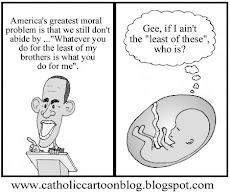
4. The Libertarian preference for the strong over the weak is decidedly un-Christian. “Leave me alone to make my own choices and spend my own money” is a political philosophy that puts those who need help at a real disadvantage. And those who need help are central to any Christian evaluation of political philosophy. “As you have done to the least of these,” says Jesus, “You have done to me.” And “Blessed are those who are just left alone” has still not made the list of Beatitudes. [Most of those in the Tea Party movement have been more influenced by Christianity than by Nietzsche and Darwinand would agree with the need to help the poor and weak. There has never been a Nietzschean libertarian government anywhere in the Western world precisely because of the influence of Christianity, so this is another straw man.] To anticipate the Libertarian response, let me just say that private charity is simply not enough to satisfy the demands of either fairness or justice, let alone compassion. [Private charity is the foundation of the Western world and far more effective, far less corrupt and much more compassionate than government welfare checks. Government to government aid to Third World countries is generally a disaster. World Vision etc. is a much better option.] When the system is designed to protect the privileges of the already strong and make the weak even more defenseless and vulnerable, something is wrong with the system. [But Wallis's real problem with private charity is not that it won't be able to deal with absolute poverty (because it clearly can do so), but rather that it can't erase relative poverty by making the rich poorer and the poor richer until everyone is about the same. Only socialism can do that.]
5. Finally, I am just going to say it. There is something wrong with a political movement like the Tea Party which is almost all white. [First, the Tea Party is not all white. Second, does this mean that Wallis' lily white Episcopal Church must also be racist? Third, this is a dirty and low blow that is an insult to the tens of millions of ordinary middle class Americans who support the Tea Party.] Does that mean every member of the Tea Party is racist? Likely not. [Every member - only likely not?!] But is an undercurrent of white resentment part of the Tea Party ethos, and would there even be a Tea Party if the president of the United States weren’t the first black man to occupy that office? [How does Wallis know that? It is nothing but sheer projection onto the people he hypocritically claims to want to dialogue with. He is saying: "You are a bunch of racist bigots; I have no evidence but I just know it. Now, how about having a nice polite dialogue?" Now who is being prejudiced here?] It’s time we had some honest answers to that question. [Oh, and by the way you are all liars too. Now for the polite dialogue?] And as far as I can tell, Libertarianism has never been much of a multi-cultural movement. Need I say that racism — overt, implied, or even subtle — is not a Christian virtue.
Subscribe to:
Posts (Atom)





 Posts
Posts


