Since the Progressive Era, classical, 19th century liberalism, which emphasizes individual liberty, free markets and small government, has been on the decline in America. During the late 19th and early 20th centuries two different trajectories have been followed.
On the one hand, the cultural elites have increasingly rejected orthodox Christianity in favor of one sort of secularist ideas or another. The influence of Darwinism, German higher criticism, and scientific positivism led to the abandonment of basic Christian doctrines, especially in the liberal Protestant denominations.
On the other hand, liberalism's concept of equality before the law or equality of opportunity, was increasingly put on the defensive by the Marxist concept of equality of outcomes embedded in the welfare state ideal. Progressives, whose philosophy was rooted in romantics like Rousseau and Marx, pushed the idea that government should ensure social equality and the catchy phrase that came to express this idea was "social justice," which was seen as clearly superior to plain old-fashioned "justice."
This new notion of equality came to be treated as equal in importance to liberty; thus we see the philosopher John Rawl attempting to square the circle of having two at least partially incompatible first principles in liberal political philosophy in A Theory of Justice. His grand attempt was a failure and showed that when push comes to shove, liberals had nothing more substantial than utilitarianism to serve as a basis for resolving conflicts between equality and liberty. Alasdair MacIntyre shows in After Virtue that this utilitarianism resolves into emotivism and depends on social consensus for its legitimacy. When social consensus breaks down, as for example on abortion after the Supreme Court's ill-considered ruling in 1973, which did so much to call into question the legitimacy and impartiality of the judiciary, emotivism serves as nothing other than a mask for a Nietzschean will-to-power.
But if the new "social justice" liberalism or "socialist liberalism" was increasingly incoherent in terms of philosophical foundations, the old, classical, 19th century liberalism suffered from a similar deficit of philosophical foundations. The problem here was the drift of the cultural elites in America away from Christianity during the Progressive Era and the inadequacy of liberal democracy without a religious foundation was exposed. Liberalism is a fine social philosophy except when it loses a pre-political concept of the Good, which was supplied in the 18-19th centuries by Christianity. This is the significance of Tocqueville's remark in Democracy in America that the American constitution was fit for a religious people and no other. It is only safe to have a constitution that fails to name the highest Good as the foundation of society if the people for whom that constitution is designed share a common faith in God, morality and the soul that provide a commonly agreed upon core of behavior that all agree is basic to political life. The classical 19th century liberalism, which left individuals freer to pursue their own ideals than any political philosophy before in history only worked because a Christian culture made it "ordered liberty" rather than something more like amoral social Darwinism.
The intellectual incoherence of liberalism, as criticized by, for example, Louis Groarke in his article: "What is Freedom? Why Christianity and Theoretical Liberalism Cannot Be Reconciled," meant that liberalism increasingly became suspect for Christians and, at the same time, increasingly vulnerable to the arguments of socialists that equality can supply the missing content in an increasingly vacuous liberalism.
Some Christians, faced with the emptiness of liberalism and lacking the courage to advocate for the Judeo-Christian worldview as the necessary basis for Western culture in an increasingly secularized social context, were seduced into thinking that the Marxist idea of equality could make the empty liberalism (often scornfully known as "neo-liberalism," especially in Europe) more humanistic. They thought that the Marxist idea of equality could serve as a substitute for the Judeo-Christian doctrine of man created in the image of God. Just as Christianity had provided a moral foundation for 19th century liberalism, so Marxism might be able to provide a moral foundation for 20th century liberalism, they thought.
After the collapse of economic Marxism in 1979 as the Soviet Union dissolved and the Chinese Communist Party embraced a kind of "crony capitalism" or "state capitalism" in a series of pragmatic reforms that recognized the necessity of the market in wealth creation but retained the dominance of the Party in Chinese society, it seemed to some that Marxism was dead. But this was an illusion. Marxism continued to serve as a substitute religion for Western liberal elites who could no longer believe in traditional Christianity by purportedly contributing to political philosophy the ideal of equality of all as the raison de etre of the state.
Liberalism in the 21st century is really an amalgam of classical liberalism (J. S. Mill) and socialism (Karl Marx) and its intellectual incoherence, unresolved by the heroic efforts of John Rawls, remains problematic. Conservatives are those who believe that 19th century liberalism plus the West's Judeo-Christian heritage provides a way forward that marries tolerance and cultural creativity with solid pre-political, religious foundations.
The Conservative critique of contemporary liberalism is that of Dostoevesky in the Grand Inquisitor scene in The Brothers Karamazov: that the West is being tempted to give up freedom in exchange for security and equality. The Grand Inquisitor represents the State which has assumed religious functions to itself and presents itself to the populace as the Great Liberator and Provider which can be relied upon to make life safe and secure. Conservatives fear that the end point of contemporary liberalism is a soft totalitarianism of the sort described in Aldous Huxley's Brave New World.
Western culture, having roused itself for one last heroic battle against the hard totalitarianisms of Fascism, Nazism and Communism in the mid-twentieth century, is now exhausted and slowly declining into the soft totalitarianism of the welfare state. The current teetering of the Euro, the decline of Europe in general and the sovereign debt crisis threatening the Western world as a whole, however, make the West vulnerable to a new hard totalitarian threat in the form of militant, oil-money fueled Islam.
The liberal response to the conservative critique is simply to say: "Don't ask us to believe in Christianity again because we can't." Yet, one get the impression that the main problem they have with Christianity is not metaphysical or scientific in nature, but simply a refusal to give up the personal anarchism (let's not dignify it with the label of freedom) of the sexual revolution. They are open to believing in any god that allows sexual license, which makes pantheistic nature-worship attractive to some and a vague moralistic therapeutic deism attractive to others. But these gods do not provide a moral core of doctrine or a theory of human nature that could fund a reinvigorated political liberalism.
So debate about whether or not Obama is a socialist is moot. It is as equally meaningless to scornfully dismiss the idea that he is a Marxist Leninist as it is to dismiss the idea that he was not born in the United States. Of course, he is not a 1930s Stalinist and of course he is not an alien. But to think that saying this means that he is not an enemy of classical liberalism or a proponent of a socialist-shaped kind of liberalism is equally ridiculous. He is a product of the 20th century fusion of the socialist ideal of equality with a drifting, incoherent political liberalism, which has been detached from its Christian roots.
What contemporary liberals need to understand, and often don't, is that the conservatives are as strongly opposed to contemporary progressivism (contemporary socialist-shaped liberalism) as they are to Marxism itself. The critique is not just about levels of taxation, amount of government regulation or social conservative moral views. The critique is far deeper and more profound that that. The basic critique of contemporary liberalism is that it lacks the philosophical foundations that are necessary to resist creeping soft totalitarianism and therefore it is inadequate as a cultural foundation for the West going forward. It is shallow, out-of-date, and dangerous, and represents a hollowed-out, secularized form of Christianity that is merely a pale reflection of the real thing, a reflection that is rapidly fading into history as the West continues its long, sad, decline.
Showing posts with label Liberalism. Show all posts
Showing posts with label Liberalism. Show all posts
Monday, June 27, 2011

Saturday, May 28, 2011
A True Liberal Rejects Romantic Utopianism
Here is one more final quote from Sinclair Lewis's It Can't Happen Here. After the fascist revolution in which Buzz Windrip comes to absolute power, the hero Doremus Jessup is engaging some introspective musing about revolution.
Alas, they don't make liberals like that anymore. Nowadays they are labelled "neocons."
"In this acid mood Doremus doubted the efficacy of all revolutions; dared even a little to doubt our two American revolutions - against England in 1776, and the Civil War.Lewis understood that there is nothing that stands so staunchly in the way of progress as "Progressivism." A true liberal is one who rejects romantic Utopianism. Who could doubt that he was a true liberal and not a leftist disguised as a liberal? Would he even be able to find a home in today's Democratic Party? And who could doubt that in a choice between Barack Obama and Paul Ryan, he would vote Ryan?
For a New England editor to contemplate even the smallest criticism of these wars was what it would have been for a Southern Baptist fundamentalist preacher to question Immortality, the Inspiration of the Bible, and the ethical value of shouting Halelujah. Yet had it, Doremus queried nervously, been necessary to have four years of inconceivably murderous Civil War, followed by twenty years of commercial oppression of the South, in order to preserve the Union, free the slaves, and establish the equality of Industry with Agriculture? Had it been just to the Negroes themselves to throw them so suddenly, with so little preparation, into full citizenship, that the Southern states, in what they considered self-defense, disqualified them at the polls and lynched them and lashed them? Could they not, as Lincoln at first desired and planned, have been freed without the vote, then gradually and competently educated, under federal guardianship, so that by 1890 they might, without too much enmity, have been able to enter fully into all the activities of the land? . . .
No questioning of the eventual wisdom of the 'radicals' who had first advocated these American revolutions, Doremus warned himself, should be allowed to give any comfort to that eternal enemy: the conservative manipulators of privilege who damn as 'dangerous agitators' any man who menaces their fortunes; who jump in their chairs at the sting of a gnat like Debs, and blandly swallow a camel like Windrip.
Between the rabble rousers - chiefly to be detected by desire for their own personal power and noteriety - and the un-self-seeking fighters against tyranny, between William Walker or Danton, and John Howard or William Lloyd Garrison, Doremus saw, there was the difference between a noisy gang of thieves and an honest man noisily defending himself against thieves. He had been brought up to revere the Abolitionists: Lovejoy, Garrison, Wendell Phillips, Harriet Beecher Stowe - although his father had considered John Brown insane and a menace, and had thrown sly mud at the marble statues of Henry Ward Beecher, the apostle in the fancy vest. And Doremus could not do otherwise than revere the Abolitionists now, though he wondered a little if Stephen Douglas and Thaddeus Stephens and Lincoln, more cautious and less romantic men, might not have done the job better.
Is it just possible, he sighed, that the most vigorous and boldest idealists have been the worst enemies of human progress instead of its greatest creators? Possible that plain men with the humble trait of minding their own business will rank higher in the heavenly hierarchy than all the plumed souls have shoved their way in among the masses and insisted on starving them?" (pp. 113-118, bolding is mine)
Alas, they don't make liberals like that anymore. Nowadays they are labelled "neocons."
Wednesday, March 23, 2011
What Does It Mean to Be Conservative?
What is conservatism? It is a series of moral, political, economic, cultural and intellectual ideals.
Moral Ideals
Sanctity of Human Life - this is the ideal you get when you apply the doctrine that people are created in the image of God
Sexual Restraint and Marriage - this is the ideal you get when you take the Ten Commandments seriously as a society
Concern for the Poor, the Weak, the Sick and the Elderly - this is the ideal you get when you take the Christian love ethic seriously
Political Ideals
Limited Government - when God is recognized as God the government can not become divinized and there are limits placed on its authority
The Rule of Law - to be ruled by law means the law applies to everyone alike and is made by bodies that operate with the consent of the governed so as to make understandable rules which are made known widely and applied without favoritism
Natural Law as the Basis of Positive Law - when human government makes law it defers to the society's best understanding of the natural law and does not try to go against the natural law
Economic Ideals
Free Enterprise - government regulation should be kept to a minimum so that many people can easily start small businesses and anti-monopoly laws should prevent the formation of monopolies so that competition can flourish
Free Markets - the markets are allowed to set prices, which eliminates "crony capitalism" and benefits everyone by ensuring that the goods and services people want are produced
Low Taxation - governments tax only for the purpose of funding the legitimate functions of government, not every Utopian project that comes along
Cultural Ideals
Family - the traditional family is seen as the pre-political basis of society and is supported by laws and government policies
Morality - objective right and wrong is acknowledged and the fallenness of humanity is taken into consideration as a fact of life
Freedom of Religion - society encourages religion and recognizes the fundamental importance of Christianity to the shaping of our culture, but draws the line at having a state church or coercing anyone to belong to a particular denomination
I think the word "conservative" is a great word and we should not let cultural Marxists take it away from us. The essence of Christianity in the Late Modern West is not to somehow "balanced" between being too liberal and too conservative. It is to be conservative rather than liberal.
Is it Cultural Captivity to be Conservative Today?
It is not often that you hear of Al Mohler and Brian McLaren agreeing on something, so it deserves to be noted when it happens. Here is Mohler responding to McLaren's critique of Mohler's critique of McLaren:
However, the general tenor of the paragraph, read quickly, seems to imply that there are two ways the church can "sell-out:" a liberal way and a conservative way, which are morally equivalent. I would argue that the liberal way leads right out of Christianity altogether. J. G. Machen, in his Christianity and Liberalism, argued this case and I think he is right. Look at the Episcopal Church today: only by excessive generosity and by ignoring reality can one call this organization a Christian Church. The fact that it has some genuine Christians in it does not affect the reality that it is firmly controlled by people who do not believe in the Biblical Gospel and who themselves need to be converted to Christ. Liberalism is an alternative to Christianity.
But conservatism is not an alternative to Christianity: it is the cultural expression of Christianity. It is Biblical discipleship in the non-religious areas of life. It was Christian influence that helped create some of the great ideals of Western civilization from limited government to freedom of religion to free markets to parliamentary democracy. Western Christendom is not beyond criticism but most of the legitimate criticism involves showing how it failed to live up to its own ideals. To seek to conserve those ideals is the essence of conservatism and it is a Biblical calling.
[In my next post, I will offer a definition of what I mean by conservatism.]
I think that Mohler is on shaky ground if he is agreeing with McLaren that much of conservative Christianity is a "sell-out to the idols of the day and a new form of Culture Christianity." Now, in Mohler's defense, he may simply be saying that conservative Christianity is selling out precisely by becoming less conservative and words in the previous line "much of presumably conservative Christianity" would seem to bear out this interpretation.Finally, McLaren agrees with me at “home plate,” though with a very different application:
Finally Dr. Mohler strides across home plate with a point I actually agree with: “At the end of the day, a secular society feels no need to attend or support secularized churches with a secularized theology.”
True enough (if by “secular” you mean “without any reference to God”), but the rub for many who identify as conservatives, I think, is that for them, secularism only comes in one flavor: liberal.
To more and more of us these days, conservative Evangelical/fundamentalist theology looks and sounds more and more like secular conservatism - economic and political - simply dressed up in religious language. If that’s the case, even if Dr. Mohler is right in every detail of his critique, he’d still be wise to apply the flip side of his warning to his own beloved community.
And, in return, I must say that McLaren lands a firm punch with this statement. He is profoundly right in seeing much of presumably conservative Christianity as a sell-out to the idols of the day and a new form of Culture Christianity. He is right to challenge us to call this what it is and to root it out.
However, the general tenor of the paragraph, read quickly, seems to imply that there are two ways the church can "sell-out:" a liberal way and a conservative way, which are morally equivalent. I would argue that the liberal way leads right out of Christianity altogether. J. G. Machen, in his Christianity and Liberalism, argued this case and I think he is right. Look at the Episcopal Church today: only by excessive generosity and by ignoring reality can one call this organization a Christian Church. The fact that it has some genuine Christians in it does not affect the reality that it is firmly controlled by people who do not believe in the Biblical Gospel and who themselves need to be converted to Christ. Liberalism is an alternative to Christianity.
But conservatism is not an alternative to Christianity: it is the cultural expression of Christianity. It is Biblical discipleship in the non-religious areas of life. It was Christian influence that helped create some of the great ideals of Western civilization from limited government to freedom of religion to free markets to parliamentary democracy. Western Christendom is not beyond criticism but most of the legitimate criticism involves showing how it failed to live up to its own ideals. To seek to conserve those ideals is the essence of conservatism and it is a Biblical calling.
[In my next post, I will offer a definition of what I mean by conservatism.]
Wednesday, March 9, 2011
Liberalism versus Liberal Fascism
This story on the recent British case, in which a Christian couple was banned from being foster parents because they would not promise to teach the children (aged 5-10 years) in their care that homosexuality is morally right, describes some of the bigger implications of this case. Christine Dhanagom points out that the judges have taken it upon themselves to define what is and is not true Christian doctrine.
So now secular courts feel free to decide what authentically Christian belief is and is not. This opens the door to persecuting traditional Christians while claiming not to be anti-Christian. The Government, just like the wicked kings of Israel and Judah in the OT, self-righteously point to their own tame, court prophets who are paid well to nod wisely and claim that everything the king wants to do is A-OK with God and God told them so.
There is, as C. S. Lewis points out in The Abolition of Man, no tyranny so evil and intrusive as that perpetrated with a clear conscience.
Dr. David Starkey is an historian and self-described "gay atheist" but he apparently is a liberal in the classical sense and not the totalitarian type of leftist that is currently campaigning to eradicate Christianity from public life. He decries the imposition of the tyrannical new liberal morality by judicial fiat and says it is just as bad as the old days when Christian morality was imposed. He and I would disagree about homosexuality, but he is an honorable man. If only all liberals were really liberal.
Liberals are civilized and easy to get along with; liberal fascists are dangerous fanatics who must be restrained in the name of the public good.
"Following the decision of London's High Court last week that a Christian couple could be banned from foster care due to their unwillingness to support the homosexual lifestyle, some commentators are pointing out that the decision amounts to a ruling on what is and is not authentic Christian doctrine.This is not liberalism, but liberal fascism.
The court's ruling found that Eunice and Owen Johns had not been the victims of religious discrimination when the Derby City Council declined their foster care application, based on the Johns' alleged inability to "promote diversity."
Despite the Johns' statement in a conversation with a social worker that their beliefs regarding homosexuality "stemmed from their religious convictions and beliefs," both the Fostering Panel and the High Court attempted to disassociate the Johns' religion from their views in support of traditional marriage in order to avoid charges of religious discrimination.
According to the Court decision, in a 2007 Panel meeting considering the Johns' application, the Fostering Panel expressed concern that its decision would not appear to discriminate against the Johns' on religious grounds.
The Panel wrote: "The department needs to be careful not to appear to discriminate against them on religious grounds. The issue has not arisen just because of their religion as there are homophobic people that are non-Christian."
In its analysis of the City Council's defense of its actions, the Court commented: "the defendant says that it has approved foster carers who are very committed Christians who hold to orthodox beliefs . . . and devout Muslim carers who are similarly committed to their religion, but who in both instances are able to value diversity notwithstanding their strongly held religious beliefs."
Refusing to overturn the Council's decision, the Court concurred that the decision was not discrimination because it was based on the Johns' disapproval of homosexuality rather than on the fact of their Christian faith.
According to the highest judicial authority of the United Kingdom, then, these two things are, apparently, separable in principle."
So now secular courts feel free to decide what authentically Christian belief is and is not. This opens the door to persecuting traditional Christians while claiming not to be anti-Christian. The Government, just like the wicked kings of Israel and Judah in the OT, self-righteously point to their own tame, court prophets who are paid well to nod wisely and claim that everything the king wants to do is A-OK with God and God told them so.
There is, as C. S. Lewis points out in The Abolition of Man, no tyranny so evil and intrusive as that perpetrated with a clear conscience.
Dr. David Starkey is an historian and self-described "gay atheist" but he apparently is a liberal in the classical sense and not the totalitarian type of leftist that is currently campaigning to eradicate Christianity from public life. He decries the imposition of the tyrannical new liberal morality by judicial fiat and says it is just as bad as the old days when Christian morality was imposed. He and I would disagree about homosexuality, but he is an honorable man. If only all liberals were really liberal.
Liberals are civilized and easy to get along with; liberal fascists are dangerous fanatics who must be restrained in the name of the public good.
One of These Things is Not Like the Others
Here is a hatchet job on Sarah Palin that tells us nothing whatsoever about Sarah Palin, but quite a lot about the leftist mind and the way in which it views the world.
David Hughes writes a post on his blog at the Daily Telegraph entitled: "What do Sarah Palin and fundamentalist Muslims have in common?" in which he notes that hardline Muslims in Britain have mounted a campaign of fear and intimidation against a Muslim academic who come out in favor of Darwinism:
So how exactly is she "just like" these 7th century fanatics? Well, you see, she expressed doubts about the holy book of Darwin and said that teaching creation and evolution side by side in schools would be a good idea so that people could make up their own minds. Imagine, freedom of thought for the masses! No wonder liberals get the shakes and fear the apocalypse.
Let's look at the difference between Palin and Islamists.
Palin: She is a conservative, which means she stands for classical, 19th century liberalism in which there is free speech, free association, freedom of religion and so on. The role of government is not to inculcate a secular or a Christian or an Islamic worldview into the population; the role of government is limited to what parents and churches and local communities cannot do such as national defense and a few other things. She believes everything that possibly can be done at the state level should be. She is a woman who demonstrates that women are competent and equal not sniveling victims. She is a Christian who is not ashamed of her faith and she is a patriot who loves her country.
Islamists: They believe in imposing their religion on everyone else by force and want to establish a theocracy in which Sharia Law reigns supreme. They do not accept free speech and want anyone who criticizes Islam to be fined, jailed or worse. They do not accept freedom of religion and believe that apostates from Islam should be killed. They oppress women mercilessly and cannot accept individual freedom or democracy (except as a means to a totalitarian theocracy as in Iran and Gaza).
Now, these two things are pretty different, I'm sure you would agree. But let's look at one more thing: Liberalism.
Liberalism: Now, by liberalism I meant the 20th century version which has been hijacked and twisted out of recognition by progressivism and socialism - the kind represented by Democratic Socialists of America, political correctness, and Barack Obama. They want to impose their secularist creed on everyone and they do not believe in freedom of religion. They do not believe in freedom of speech; in fact, they are constantly pushing speech codes that force people to speak in politically correct ways or face punishment, harassment and shaming. They are intolerant of Christianity and love to promote Islam as a counterbalance to Christianity. Multiculturalism is a great excuse to systematically eradicate Christianity from the public square in the West. They are collectivists and do not trust individuals with too much freedom.
Now, as they say on Sesame Street, one of these things is not like the others. Which one?
Why, it seems to me that Liberalism and Islamism are much closer in spirit to one another than either is to Sarah Palin.
David Hughes writes a post on his blog at the Daily Telegraph entitled: "What do Sarah Palin and fundamentalist Muslims have in common?" in which he notes that hardline Muslims in Britain have mounted a campaign of fear and intimidation against a Muslim academic who come out in favor of Darwinism:
The hounding of Dr Usama Hasan, a science lecturer at Middlesex University and a fellow of the Royal Astronomical Society, following a lecture he gave on evolution is turning ugly. The First Post reports that Hasan has been forced to retract his assertion that Darwinism is compatible with Islam after receiving death threats. He delivered his message in a lecture at the Masjid al-Tawhid mosque in Leyton and was accused of “blasphemy” by some in the audience and even branded an apostate who should be killed. His father, Suhaib, head of the mosque’s committee of trustees, has now issued a statement on his son’s behalf which read: “I seek Allah’s forgiveness for my mistakes and apologise for any offence caused.” The climbdown exposes the depth of feeling on this issue among some Muslims.He then has the temerity to assert that Sarah Palin is just like these illiberal brutes. And why does he think this? Has Palin issued death threats to Christian scholars who teach evolution? No. Well, has she called for making the teaching of evolution illegal? Actually, no. Does she advocate the killing of anyone who abandons the Christian religion? No, she hasn't done that either.
So how exactly is she "just like" these 7th century fanatics? Well, you see, she expressed doubts about the holy book of Darwin and said that teaching creation and evolution side by side in schools would be a good idea so that people could make up their own minds. Imagine, freedom of thought for the masses! No wonder liberals get the shakes and fear the apocalypse.
Let's look at the difference between Palin and Islamists.
Palin: She is a conservative, which means she stands for classical, 19th century liberalism in which there is free speech, free association, freedom of religion and so on. The role of government is not to inculcate a secular or a Christian or an Islamic worldview into the population; the role of government is limited to what parents and churches and local communities cannot do such as national defense and a few other things. She believes everything that possibly can be done at the state level should be. She is a woman who demonstrates that women are competent and equal not sniveling victims. She is a Christian who is not ashamed of her faith and she is a patriot who loves her country.
Islamists: They believe in imposing their religion on everyone else by force and want to establish a theocracy in which Sharia Law reigns supreme. They do not accept free speech and want anyone who criticizes Islam to be fined, jailed or worse. They do not accept freedom of religion and believe that apostates from Islam should be killed. They oppress women mercilessly and cannot accept individual freedom or democracy (except as a means to a totalitarian theocracy as in Iran and Gaza).
Now, these two things are pretty different, I'm sure you would agree. But let's look at one more thing: Liberalism.
Liberalism: Now, by liberalism I meant the 20th century version which has been hijacked and twisted out of recognition by progressivism and socialism - the kind represented by Democratic Socialists of America, political correctness, and Barack Obama. They want to impose their secularist creed on everyone and they do not believe in freedom of religion. They do not believe in freedom of speech; in fact, they are constantly pushing speech codes that force people to speak in politically correct ways or face punishment, harassment and shaming. They are intolerant of Christianity and love to promote Islam as a counterbalance to Christianity. Multiculturalism is a great excuse to systematically eradicate Christianity from the public square in the West. They are collectivists and do not trust individuals with too much freedom.
Now, as they say on Sesame Street, one of these things is not like the others. Which one?
Why, it seems to me that Liberalism and Islamism are much closer in spirit to one another than either is to Sarah Palin.
Thursday, March 3, 2011
Short Notices
Here are some stories worth reading that I don't have time to comment on extensively at the moment but which are important enough to take time to draw to your attention.
Michael Moore is a totalitarian who thinks that the total amount of money is finite, that all the money belongs the government, and that jobs are owned by "the people." He knows nothing about economics, yet sees fit to pontificate anyway. He is filthy rich capitalist himself, yet poses as a Marxist. Quite a piece of work! See here for proof.
Kermit Gosnell, abortionist and murderer, may get the death penalty according to CNN. If ever there was a case where the death penalty was warranted, this is it.
Barrack Obama should be considered to be an enemy of the Roman Catholic Church. Father Z comments on William Oddie's article that makes a case for this proposition here.
Khalid Ali-M Aldawsari was recently arrested by the FBI after he was discovered to have been planning a terrorist attack in Texas. One of his potential targets was George W. Bush. This is the 38th thwarted terrorist attack in the US since 9/11.
Ruth Marcus is a left-leaning journalist who is getting tired of Obama's lack of leadership. When you have lost the Washington Post, you are in trouble.
George Will explains why liberals love trains in Newsweek. Short answer: because they love to control other people's lives.
Shahbaz Bhatti, Pakistan’s minister of minority affairs, was assassinated by gunmen today while he sat in a car outside his mother’s house, where he lived. See Nina Shea's article in The Corner. His crime? Trying to reform Pakistan's totalitarian blasphemy laws.
Damian Thompson asks when Britain will wake up to the persecution of Christians by Muslims here. He documents the murder of Pakistan's Minister of Minorities, the massacre of Copts by Muslims, and the persecution of Christians in Iraq. But my question is: "Is Damian right to assume that the governing elites of Broken Britain are really against this sort of thing?"
Monday, January 17, 2011
Political Liberalism, RIP
Rick Moran at American Thinker Blog reflects on an article in the Weekly Standard by P. J. O'Rourke entitled "The Times Loses It" asking if liberalism is dead. He quotes O'Rourke as follows:
The homosexual who just wants to be left alone but does not want to effect a social revolution and the women who simply want fairness but reject Marxist analysis increasingly have no voice on the Left. They are simply "officially approved victims" who have a useful role to play in the revolution whether they like it or not.
Real Liberalism as described by O'Rourke made an alliance with conservatives against Marxist revolution and dictatorship. In exchange for the creation of the welfare state, they agreed to oppose Communism. But now the alliance has ended and, having attained the welfare state liberals now want more and find themselves in bed with socialists and full-blown Marxists like Bernie Sanders and Van Jones. There is no future for liberalism as a political philosophy or a movement in that alliance. They are merely cannon fodder, useless idiots and respectable front men. The hard men in the background call the shots.
Is this the end of liberalism in the West? I fear so. The choices now become much harder and the only defenders of individual liberty left are conservatives. To be liberal now is to be conservative. It really has come to that.
A reaction so disproportionate and immaterial to a news story by a news organization is indicative of trouble in the body politic-trouble almost as severe as that which the Times claims the Giffords shooting indicates. I worry that in the tremors and hysteria of the Times we're seeing the sad end of liberalism.The reason I refer to "The Left" a lot on this blog is that for the past 50 years liberals have increasingly lost vigor and energy and have allowed themselves to be co-opted by socialists sympathetic to the New Left and by the New Left itself. All the energy and passion on the left is on the far left and what used to be the liberal center no longer holds. Increasingly politics is polarized into a right versus left confrontation as in the homosexual rights movement, extreme feminism and redistributionist tax and spend social democracy.Its passing is to be mourned, perhaps most by true conservatives. Civilization owes a debt to liberal politics. From the Reform Act and the religious emancipation fight of the British Whigs to the American civil rights movement, liberals have in fact held positions on political high ground (though not during Clinton's exploitation of the Oklahoma City bombing). Liberals have seen government as a force for good, and sometimes it can be. World War II comes to mind. While conservatives have delighted in the free market, liberals have been there to remind us that all freedoms, including market freedoms, entail responsibilities. At the very least it can be said that we conservatives would not be so upright in our ideals if we hadn't been pushing against liberals.
But liberalism, as personified by the New York Times, became a dotty old aunt sometime during the Johnson administration. She's provincial, eccentric, and holds dull, peculiar views about the world. Still, she has our fond regard, and we visit her regularly in her nursing home otherwise known as Arts and Leisure and the Book Review. Or we did until Sunday, January 9, when she began spouting obscenities and exposing herself.
We observe in the Times a bizarre overreaction to people and things that can be construed as "antigovernment." (And all people and most things often can be so construed, e.g., the man who just got a speeding ticket.) The Times has become delusional, going from advocating big government to believing that it is the big government. Americans being somewhat disgruntled with big government, the Times imagines itself under attack from every side, even, no doubt, from within.
The homosexual who just wants to be left alone but does not want to effect a social revolution and the women who simply want fairness but reject Marxist analysis increasingly have no voice on the Left. They are simply "officially approved victims" who have a useful role to play in the revolution whether they like it or not.
Real Liberalism as described by O'Rourke made an alliance with conservatives against Marxist revolution and dictatorship. In exchange for the creation of the welfare state, they agreed to oppose Communism. But now the alliance has ended and, having attained the welfare state liberals now want more and find themselves in bed with socialists and full-blown Marxists like Bernie Sanders and Van Jones. There is no future for liberalism as a political philosophy or a movement in that alliance. They are merely cannon fodder, useless idiots and respectable front men. The hard men in the background call the shots.
Is this the end of liberalism in the West? I fear so. The choices now become much harder and the only defenders of individual liberty left are conservatives. To be liberal now is to be conservative. It really has come to that.
Thursday, December 9, 2010
Sarah Palin Shoots a Caribou and Makes A Liberal's Head Explode
The Guardian, which specializes in treating liberal hypocrisy with a seriousness it does not deserve, devotes several column inches to the incoherent raging of Aaron Sorkin over the fact that Sarah Palin went hunting and killed a caribou.
West Wing creator Aaron Sorkin today gave Sarah Palin both barrels over her US TV reality show, accusing the contender for the 2012 Republican presidential nomination of shooting an animal "for political gain".
Sorkin, writer of the recent Facebook movie The Social Network, also accused the Fox News contributor of making a "snuff film" after the latest episode of Sarah's Palin's Alaska featured the politician going hunting with her father and shooting a caribou.
He described Palin as "deranged", a "witless bully" and a "phony pioneer girl". He also said The Learning Channel, the US cable network, "should be ashamed of itself" for broadcasting her "truly awful reality show".
Sorkin was responding to a post on Palin's Facebook page in which the former governor of Alaska reacted to criticism of Sunday's episode by accusing her detractors of hypocrisy: "Unless you've never worn leather shoes, sat upon a leather chair or eaten meat, save your condemnation."
"I eat meat, chicken and fish, have shoes and furniture made of leather ... I'm able to make a distinction between you and me without feeling the least bit hypocritical," Sorkin wrote in an incendiary comment piece posted on the Huffington Post website early today.
"I don't watch snuff films and you make them. You weren't killing that animal for food or shelter or even fashion, you were killing it for fun. You enjoy killing animals," he added.
Good grief! What kind of perverted mind supports a law that enables men to pressure their girlfriends into aborting their baby just because that baby is a girl or might have Downs Syndrome or has just come along at an inconvenient time and then gets this bent out of shape over killing a caribou? I mean, there is something seriously pathological about the liberal conscience for it to be aroused to fever pitch over an animal and utterly unfeeling and apathetic over a fellow human being.
Liberals must not just think the fetus is non-human; they must think that when we were fetuses we were somehow lower than the animal level - vegetables perhaps. Then suddenly on the way down the birth canal just before crowning presto: the vegetable magically skips the animal level and suddenly turns into a human being: you and me. Unless, of course, you are Peter Singer in which case you don't think it becomes human until two years of age or so.
So all hunting shows are now "snuff films?" All hunters are morally evil? Well, rural America and Canada, now you know how the Ruling Class regards you. It sure explains a lot - like gun control for example. And here I was laboring under the misunderstanding that they wanted the gun registry because they were afraid people would be killed by guns. Turns out they were afraid you might sneak off and shoot a rabbit or deer. The horror!
I just think it is sickening to assert that there is something morally evil about killing an animal for sport. It betrays a lack of clear thinking about what makes killing evil. The human versus non-human distinction is vital to clear reasoning and moral evaluation. Once it is blurred all sorts of weird and contradictory conclusions are drawn by those who have lost their moral compass.
Mr. Sorkin, save your outrage for the murder of your fellow human beings. And take your anti-rural, anti-hunter, anti-anybody different from you prejudice back with you to the jungles of urban America where the only hunting that is done is the hunting of women by predators empowered by the sexual revolution that liberals like you consider to be progressive.
But what can be expected from a druggie who supports MoveOn and has reportedly dated Maureen Dowd? And he thinks Sarah Palin is wacky . . . for going hunting?Friday, December 3, 2010
Thursday, December 2, 2010
What is at Stake in "Don't Ask Don't Tell"?
For all the talk I hear about this issue, I never hear the real heart of the issue addressed. This shows that the pro-sexual revolution activists are succeeding in framing the debate on their terms and, as I learned in high school parliamentary-style debating, whoever gets to define the terms of the debate has a huge advantage and is likely to win regardless of the merits of the two positions themselves.
All the debate surrounds the supposed harm done to homosexuals who have to "hide" their behavior and not have it "affirmed" as good by those around them. Those opposed to changing the policy talk of "combat effectiveness" and "morale issues," which seem pretty ambiguous and hard to nail down. Defined this way, the traditional view is going to lose.
What stands out to me are facts like these: (1) homosexuals are not hunted down and thrown out of the military, (2) homosexuals are not being discriminated against in terms of promotion or rewards, and (3) no one is telling homosexuals that they have to agree with traditional sexual morality that says that homosexuality is morally evil.
What is at stake here is not the rights of homosexuals to be left alone like other minorities, but a change to the views of the majority to embrace homosexuality as good. This is what the activists want: they want people like me to change our morality. My question is to them is: if we leave can you alone, why can't you leave us alone?
The open "recognition" the activists demand is not "tolerance." They already have that but they are not satisfied with mere tolerance. Yet tolerance is all that any minority has a right to demand in a liberal society. As an Evangelical I can't demand that everybody abandon their own faith and embrace key tenets of mine just because I feel that I am diminished in some way by the lack of affirmation I receive from my work colleagues or the government. What I have right to demand is the right to be left alone to practice my religion as I see fit and to have my request for conscientious objection to certain things taken seriously. These minimal standards of tolerance are possible for everyone in society. But to demand that everyone approve of my lifestyle and regard it as equal to their own is simply impossible.
Here we come to the heart of the problem. Pro-sexual revolution activists insist that traditional Christians, Jews, Muslims and others change their sincerely-held religious views to agree with them. This is intolerant, illiberal and authoritarian. It is inconsistent with a liberal democratic society. It is like Evangelicals coercing everyone else in society into going to church every Sunday or Catholics forcing everyone else in society to recognize the Pope's authority.
If the "Don't ask, don't tell" policy is repealed, the result will not be more toleration and openness in society, but less. It will represent the victory of secularism over Christianity and Judaism. It will represent the imposition of one particular morality on everyone without respect for conscience or tradition.
In Canada, we have experience with same-sex "marriage" laws and we see what they are really designed to do. They are designed to provide a legal framework for the imposition of one particular morality on everyone by coercion. They represent a rationale for rejecting claims to conscientious objection. They give the most radical activists among us the legal standing to eradicate all traditional, Judeo-Christians morality and natural law from the public square.
If "Don't ask, don't tell" is repealed, the most likely result will be the loss of hundreds and hundreds of Evangelical Christian military chaplains. They will gradually be forced out as a "pro-homosexuality" morality is imposed on the chaplaincy. It will be gradual but the pressure will be steady and many people will be tempted to compromise out of agony of conscience. Others will "go underground" and try to keep their heads down while realizing that they are vulnerable to be "outed" and court-martialed at any time.
The end result will not be a more tolerant and accepting institution but simply one in which traditional Christianity is treated more harshly than homosexuals are treated today. It will be a situation in which traditional Christians have fewer rights than homosexuals currently have. How does that make society more just or tolerant?
Monday, November 29, 2010
10 Things Liberals Believe That are Just Not Believable to Most of the Rest of Us
1. That spreading condoms around and teaching people that using them in promiscuous sexual relationships is safe.
2. That anthropocentric global warming is a proven fact beyond all reasonable doubt.
3. That a massive transfer of wealth from the West to Third World governments via a UN administered banking transaction tax will save the planet from the disasters that will follow global warming.
4. That affirmative action and racial quotas are not racist.
5. That permanent welfare is good for poor people.
6. That all conservatives are stupid and all liberals are smart.
7. That it makes no difference to the welfare of children whether or not they are brought up by their married, biological parents.
8. That sex education for primary school children is anything other than desensitization and propaganda for the sexual revolution.
9. That an atheistic society is just as likely to have high moral standards and concern for the neighbor as a Christian one.
10. That it makes no difference to our self-image and self-respect to believe that we are evolved by chance from animals rather than being created specifically in the image of God by the Creator.
Wednesday, October 20, 2010
The Hypocrisy of Liberals/Progressives on Religion
Hunter Baker has a good post on "The Hypocrisy of the Champions of Secular Democracy" in which he points out that the recent attacks on Rand Paul's (Republican candidate for the Senate in Kentucky) faith by his Democratic opponent, Jack Conway, is an example of the way that liberals use the "separation of church and state" as a stick with which to beat conservatives. You can't take them seriously, so why try?
Baker writes:
Here is Rand Paul's response:
If a conservative Christian argued that his opponent should not be elected because he was an atheist and anti-Christian, the liberals would be up in arms. But their silence on this issue shows how hypocritical they are. They just cynically use the religion issue either way as it suits their purposes.
Baker again:

Baker writes:
In my book The End of Secularism, I have a chapter which is a case study demonstrating that the high-minded adherence to secularism is easily discarded by leftists whenever they find religion convenient to their agenda. Were I to rewrite the book today, I would include the ad being run against Rand Paul by his opponent in the Kentucky senate race.Here is the Democratic attack ad:
Here is Rand Paul's response:
If a conservative Christian argued that his opponent should not be elected because he was an atheist and anti-Christian, the liberals would be up in arms. But their silence on this issue shows how hypocritical they are. They just cynically use the religion issue either way as it suits their purposes.
Baker again:
Now, first off, I have to say that the claim against Rand Paul has to do with a stunt from his college years at Baylor. Having read the original story about Rand's classmate's claim, it was clear that he and a friend engaged in a fairly typical fraternity-style prank. I am familiar with the "secret society" he belonged to at Baylor. It is a humorous part of campus-life. A little edgy, but viewed as a real part of the Baylor tradition.
More important, though, the text of the ad shows that liberals are more than ready to use religion as a political issue when it suits their purposes. If the shoe were on the other foot and a conservative were running an ad of this nature, many gray eminences of church-state separation would come forth from the Ivy Leagues, Washington, D.C., and New York City to explain to us how scurrilous and unprincipled it is.
I have yet to hear from Barry Lynn or any of the other great separators of church and state about the Conway ad being run against Rand Paul. And we won't hear from them. Because this story doesn't fit their template of conservatives using religion to engage in holy war.
Well said Mr. Baker.
Monday, October 18, 2010

Wednesday, October 6, 2010
Is it Fair to Call Obama a Socialist When He is Clearly a Progressive?
The answer is "yes." Let me explain why.
Socialism never really got off the ground in America in the late 19th century as it did in Europe. And after WW I socialism still didn't really find traction. However, progressivism did become a major ideology in American political economy from Woodrow Wilson onwards. Norman Thomas, who ran for president six times as a socialist, predicted that Americans would never elect a socialist but they would elect someone with a socialist ideology who labeled himself a "liberal." In 2008 his prediction came true.
I want to deal with the objection that it is not fair to call Obama a socialist because he is really a progressive and there is a great deal of difference between the two. It is interesting how the Left insists on highly detailed nuance between the different shades of left wing politics, yet is hypocritically eager to label everyone to the right of center a "fascist" or "Nazi." But on their side of the spectrum a socialist is different from a communist and a progressive is different from a socialist and the criticisms which apply to one do not apply to the other.
The Left has taken over a perfectly good word "liberalism" and utterly corrupted it. Classical 19th century liberalism means free enterprise, limited government, the rule of law and individual liberty. Reagan and Thatcher were liberals and so are most conservatives. But the Left has co-opted this word from the New Deal era on and made it a synonym of progressive. Now, with the word liberal having become a dirty word, many US politicians such as Hilary Clinton and Barack Obama are going back to the word progressive, the original meaning of which has been forgotten by many members of the public.
In the first half of the 20th century progressives were influenced by the ideas of the likes of Charles Darwin, John Dewey, and Margaret Sanger and were inspired by the Russian Revolution. During this period, however, it was expedient for the Left to portray progressive programs such as legislation in support of trade unions, the growth of the welfare state, and increasing government involvement in the economy as a way of staving off communist revolution. The idea was that if we give the working class concessions, we can buy them off and thus prevent their radicalization. Progressives wrapped themselves in the flag and heartily proclaimed their fealty to the American way and labor unions expelled communists from their leadership.
But progressivism has its roots in the same worldview as Marxism. In the late 19th century, ideas such as progress, Darwinism, materialism, and a dualistic view of the human person were the roots of a general tendency toward social engineering evident in various kinds of Marxism, various kinds of socialism and progressivism. An example was eugenics, the attempt to improve the human race by preventing the poor and the "inferior" races from reproducing and encouraging the rich, white population to reproduce more. The fact that such ideas were taken up into Nazism and led to genocide hurt, but did not destroy, their credibility on the Left in general. The late 20th and early 21st century has witnessed a comeback of racist eugenics as the most extreme form of the social engineering that has characterized all 20th century totalitarianisms, including socialism. This is why almost all socialists are pro-abortion.
So replacing socialism or communism with progressivism is like replacing deep fried foods in your diet with high salt prepared foods; you are eating differently, but not necessarily better. Progressivism should be understood as the form that socialism takes in a country in which it faces a strong and determined opposition from conservative Christianity and strong traditions of democratic capitalism. Just as democratic socialism is what you get when the socialist parties are not strong enough to seize total control, progressivism is what you get when even democratic socialism cannot win elections.
Why am I so skeptical about the possibility that progressivism is not really an alternative to socialism? Well, first it must be admitted that some progressives are totally sincere in seeing the movement of which they are a part in this way. In their mind, that is the truth; they truly hate socialism and all forms of totalitarianism. But the reason I think they are deluded, in the final analysis, is that they fail to recognize that that materialistic, evolutionary, worldview of socialism and communism is also the worldview of progressivism and that, in the end, this general set of philosophical beliefs will be far more important than any policy details such as whether the economy should be mixed or how much freedom the market should be allowed to have at any given time. The view of the human person common to communism, socialism and progressivism is antithetical to the Christian understanding of the human person.
For this reason, it is better to regard progressivism as a way station on the way to socialism and totalitarianism, than as a real alternative to totalitarianism. From Toronto you can get to San Francisco by way of Chicago or by way of Mexico City. One way is more direct, but you end up in the same place eventually. I'd rather not go to San Francisco at all.
Monday, October 4, 2010
Revel on Why Socialism is an Ideology and Liberalism is Not
Jean-Francois Revel is a major French thinker, who is relatively unknown in the English-speaking world, but has written a number of books skewering Communism, Socialism and the mindless anti-Americanism which is rampant in France. He is unable to believe that socialism has not gone out of business after the fall of the Soviet Union and probes into why this is not the case.
His last book, La Grande Parade: Essai sur la survie de ll'utopie socialiste, has now been translated into English under the title: Last Exit to Utopia: The Survival of Socialism in a Post-Soviet Era. Writing in a country where the Soviet-controlled Communist Party actually won seats and posed a serious threat, although it never was able to seize total power, Revel writes with a realism born of experience with actual socialism that eludes many idealistic Americans.
Here is Revel on ideology:
(Note: he is using the word "libleralism" in its classic 19th century sense of free enterprise, individual liberty, limited government etc., not in its late 20th century meaning of socialism lite. The only classical liberals in America today are known as conservatives because the center has shifted leftward.)
First, it is no wonder that socialists cannot understand capitalism. They make capitalism into their devil because they misinterpret it as if it were an ideology.
Second, capitalism and liberalism are scientific and socialism is irrational.
Third, Christianity has nothing whatsoever to learn from socialism - not its earthly Utopianism, not its critique of capitalism, not its worship of economic equality, not its materialism - nothing.
Fourth, if socialism is an ideology and an ideology is a totalizing dogma, then socialism is incompatible with the Gospel of Jesus Christ, which shatters all such totalizing dogmas.
Fifth, if socialism destroys the free will of the individual, as Revel claims, then socialism is an attack on the dignity of man created in the image of God and therefore fundamentally anti-humanistic.
I think Revel's description of socialism as an ideology and his definition of ideology ring true to the historical implementation of socialism in the 20th century. Therefore, I believe the above implications are valid. I will have more quotations from Revel in coming days. It is taking me some time to read and digest his book, which I highly recommend.
His last book, La Grande Parade: Essai sur la survie de ll'utopie socialiste, has now been translated into English under the title: Last Exit to Utopia: The Survival of Socialism in a Post-Soviet Era. Writing in a country where the Soviet-controlled Communist Party actually won seats and posed a serious threat, although it never was able to seize total power, Revel writes with a realism born of experience with actual socialism that eludes many idealistic Americans.
Here is Revel on ideology:
(Note: he is using the word "libleralism" in its classic 19th century sense of free enterprise, individual liberty, limited government etc., not in its late 20th century meaning of socialism lite. The only classical liberals in America today are known as conservatives because the center has shifted leftward.)
"A perennial misapprehension distorts virtually all discussions about the competing merits of socialism and liberalism: Socialists like to imagine that liberalism is an ideology. Reared on ideology themselves, they cannot imagine that any other form of intellectual activity exists, so they constantly detect in others the same propensity toward abstract and moralistic systematizing by which they themselves are possessed. Socialists are convinced that opposing doctrines are an inverted imitation of their own, and that these opposing doctrines are an inverted imitation of their own, and that these opposing doctrines must be promising absolute perfection, albeit by a different route. And liberals, reflexively complaint as always, have too frequently accepted this grossly mistaken view of their own position.If Revel is right in his argument here, several points follow.
If a liberal asserts, 'In practice, the market seems to be a less inefficient means of allocating resources than top-down, planned distribution,' a socialist will immediately shoot back, 'The market is not a solution to every problem.' Of course not. Who ever maintained such an absurdity? But since socialism was conceived in the delusion of being able to resolve every problem, its partisans project the same ambition onto their opponents. Fortunately, not everyone shares their megalomania. Liberals have never aimed to build a perfect society. They are content to compare the various types of societies that exist or have existed, and to draw appropriate conclusions from studying those that have functioned the least badly. . .
Liberalism has never been an ideology, by which I mean a theory based on a priori concepts; nor is it an unchanging dogma divorced from the course of events and outcomes. It is merely a set of observations on facts. The general ideas derived from these observations do ot constitute a global doctrine aspiring to comprehensiveness, but rather a series of interpretive hypotheses concerning real world events. Adam Smith, when he undertook to write The Wealth of Nations, noticed that some countries were richer than others. He attempted to locate in their economic arrangements the features and practices that could account for such disparities, with the practical goal of being able to recommend prudent policies. . . .
As an a priori construction, formulated without regard to facts or ethics, ideology is distinct from science and philosophy on the one hand, and from religion and ethics on the other. Ideology is not science - which it pretends to be. Science accepts the results of the experiments it devises, whereas ideology systematically rejects empirical evidence. It is not moral philosophy - which it claims to have a monopoly on, while striving furiously to destroy the source and necessary condition of morality: the free will of the individual. the basis of morality is respect for the person, whereas ideology invariably tramples on the person wherever it reigns. Ideology is not religion - to which it is often, and mistakenly, compared; for religion draws its meaning from faith in a transcendent reality, while ideology aims to perfect the world here below.
Ideology - that malignant invention of the human spirit's dark side, an invention which has cost us dearly - has the singular property of causing zealots to project the structural features of their own mentality onto others. Ideologues cannot imagine that an objection to their abstract systems could come from any source other than a competing system.
All ideologies are aberrations. A sound and rational ideology cannot exist. . . . The confrontation between socialism and liberalism is not a confrontation of ideologies. Liberalism is not upside-down socialism; it it not a totalizing ideology governed by intellectual rules equivalent to those it criticizes."
First, it is no wonder that socialists cannot understand capitalism. They make capitalism into their devil because they misinterpret it as if it were an ideology.
Second, capitalism and liberalism are scientific and socialism is irrational.
Third, Christianity has nothing whatsoever to learn from socialism - not its earthly Utopianism, not its critique of capitalism, not its worship of economic equality, not its materialism - nothing.
Fourth, if socialism is an ideology and an ideology is a totalizing dogma, then socialism is incompatible with the Gospel of Jesus Christ, which shatters all such totalizing dogmas.
Fifth, if socialism destroys the free will of the individual, as Revel claims, then socialism is an attack on the dignity of man created in the image of God and therefore fundamentally anti-humanistic.
I think Revel's description of socialism as an ideology and his definition of ideology ring true to the historical implementation of socialism in the 20th century. Therefore, I believe the above implications are valid. I will have more quotations from Revel in coming days. It is taking me some time to read and digest his book, which I highly recommend.
Wednesday, September 22, 2010
Why are Liberals So Intolerant?
Carson Holloway has some sharp insights on "The Sources of Liberal Intolerance" at Public Discourse.
Read the rest here. A few comments.Liberal intolerance is rooted in a secular disregard for the dignity of individuals, coupled with the veneration of Progress and the belief that liberal ideologies can’t win in public debate.American conservatives frequently complain that American liberals are intolerant—a striking paradox for a political movement whose very name suggests a respect for freedom. In their political rhetoric, liberals frequently resort to demonization, claiming, for example, that those who oppose same-sex marriage are animated by irrational hatreds. In the realm of public policy liberals openly desire to regulate communications media, like talk radio, that promote conservative ideas. Indeed, contemporary liberals routinely defend speech codes in the universities, which an older generation of liberals defended as bastions of untrammeled discourse. The complaint is so familiar, and the examples so numerous, that further elaboration of the phenomenon could serve no useful purpose.
What might serve some useful purpose, however, is an effort to reveal the roots of this intolerance. Tolerance is a delicate plant that does not grow easily in the soil of humanity. To some extent, then, liberal intolerance is simply a reflection of the ordinary weakness of human nature, which in all men yearns to silence those whose opinions differ too widely from their own. . . .
In the first place, liberals are drawn into intolerance by their belief in progress, or rather Progress. The contemporary left is, to a considerable extent, committed to the notion that history, or rather History, moves according to a rational, discernible purpose, specifically in the direction of a gradual but irreversible amelioration of the human condition, understood especially as an ever-increasing equality. At first sight, one might expect that such a belief would actually foster tolerance. After all, why should one bother to silence non-progressive views if Progress is fated to advance no matter what anyone does? But it does not work out that way. Instead, the liberal belief in Progress causes liberals to view any expression of what they regard as retrograde opinion to be a threat to the very foundations of their worldview.
In the second place, contemporary liberalism is prone to intolerance because some of its most cherished political and cultural aspirations are at odds with the deeply-rooted moral convictions of the American society it is trying to reform.
Finally, the left is intolerant because it tends to be secular, and as a result is less able to respect the dignity of the individual human person. The Western tradition finds support for human dignity in the biblical belief that every human being is created in the image and likeness of a transcendent God. . . . Modern American liberals have to a considerable extent shaken off such theological convictions. In their place, many liberals have embraced Darwinism, understood not merely as a scientific explanation of the biological mechanisms of evolution but as a comprehensive account of man’s ultimate origins. Darwinism thus understood, however, purports to “know” that human beings emerged merely through the interplay of chance and necessity, and that they differ from other animals not in kind but only in degree. . . .
Thus we often find liberals seeking to advance the cause of social justice, as they understand it, by doing injustice to individuals.
First, since contemporary liberalism makes "Tolerance" its first principle of practical reason and its highest virtue, for it to fail even to be tolerant makes it a complete and total failure as a political philosophy even judged by its own internal standards.
Second, we must remember that contemporary liberalism is not classical 19th century liberalism, but is a form of liberalism that has surrendered in large part to socialist thinking. Contemporary liberalism allows Marxists to pose as insiders to Western political systems rather than appearing as an outside enemy seeking to destroy the system. The intolerance of contemporary liberalism arises out of the mixing of revolutionary Marxism with liberal thought to create something antithetical to the Western tradition.
Saturday, September 18, 2010
Peggy Noonan's Yardstick and Fundamental Political Change
Peggy Noonan was a speechwriter in the Reagan White House and she is now a respected columnist for the Wall Street Journal. She got caught up in the religious hysteria surrounding Barack Obama a couple of years ago and so she is now regarded by conservatives with the same suspicion attached to wobbly ex-conservatives like David Brooks and David Frum, who appeared to have joined the Ruling Class.
But Noonan's writing is occasionally brilliant and one can easily see why she was a very effective speechwriter. In her latest WSJ column she uses the metaphor of the yardstick to explain in simple terms how the Left has been successful in shifting the political spectrum left-ward during the past half century or so. With the collapse of the liberal center, the choices have increasingly come down to conservative or socialist. Noonan explains:
But Noonan's writing is occasionally brilliant and one can easily see why she was a very effective speechwriter. In her latest WSJ column she uses the metaphor of the yardstick to explain in simple terms how the Left has been successful in shifting the political spectrum left-ward during the past half century or so. With the collapse of the liberal center, the choices have increasingly come down to conservative or socialist. Noonan explains:
I see two central reasons for the tea party's rise. The first is the yardstick, and the second is the clock. First, the yardstick. Imagine that over at the 36-inch end you've got pure liberal thinking—more and larger government programs, a bigger government that costs more in the many ways that cost can be calculated. Over at the other end you've got conservative thinking—a government that is growing smaller and less demanding and is less expensive. You assume that when the two major parties are negotiating bills in Washington, they sort of lay down the yardstick and begin negotiations at the 18-inch line. Each party pulls in the direction it wants, and the dominant party moves the government a few inches in their direction.
But if you look at the past half century or so you have to think: How come even when Republicans are in charge, even when they're dominant, government has always gotten larger and more expensive? It's always grown! It's as if something inexorable in our political reality—with those who think in liberal terms dominating the establishment, the media, the academy—has always tilted the starting point in negotiations away from 18 inches, and always toward liberalism, toward the 36-inch point.
Democrats on the Hill or in the White House try to pull it up to 30, Republicans try to pull it back to 25. A deal is struck at 28. Washington Republicans call it victory: "Hey, it coulda been 29!" But regular conservative-minded or Republican voters see yet another loss. They could live with 18. They'd like eight. Instead it's 28.
This is brilliant exposition. Noonan is right that the Tea Party is challenging and changing both parties. The historical significance of the Tea Party movement is that it may very well pull the Republican Party back toward the right, the Democratic Party back toward the right and thus create a new center. If it does so, it will go some way to restoring the liberal democratic center that used to form the center of American politics with both parties overlapping much of it.
This means that the re-alignment now occurring in American politics may be as significant as that which occurred during the late 60s and early 70s when the Left took over the Democratic Party and shifted the center to a big government, high tax, welfare state position uneasily poised between socialism and liberalism. Or to put it another way, American politics was moving toward a European model where the voting public was usually presented only with two choices: socialism and socialism implemented more slowly.
It is not always remembered that there were two radical movements that trace their origins to the 1960s. In addition to the well-known New Left, the 60s also witnessed the birth of Goldwater conservatism, which eventually led to the election of Ronald Reagan in 1980. If the Tea Party movement succeeds in restructuring American politics in the way Noonan describes, we could be witnessing the fourth phase of the revival of American Conservatism that arose after World War II.
The first was the rise of the coalition brokered by William F. Buckley and National Review in the 50s between national security hawks, libertarians and traditional conservatives. The second was the Goldwater campaign in the mid-60s and the move of the liberal refugees from the Democratic Party into the Republican camp as Neo-conservatives. The third was the rise of the Religious Right and Reagan years and the fourth is the Tea Party era featuring the actual shrinking of the federal government for the first time in a century.
Will we look back a decade from now and view the Obama phenomenon as the last gasp of the New Deal? Will the Tea Party movement be credited with a fundamental re-alignment of the American political spectrum? Are we living in a time of change as deep and far-reaching as the 1960s? Only time will tell.
Friday, September 17, 2010
Understanding the Liberal Mind 2: Why the Tea Partiers "Must" Be Racist
If you have read anything in what Sarah Palin consistently refers to as "the lamestream media" over the past few months - and, unfortunately many people are immersed in it exclusively as their source of news and opinion - you will have read accusations that the Tea Party is racist. Sometimes it is in the form of breathless revelations, other times it is insinuated, while other times it is tossed off as a piece of conventional wisdom that "everybody" knows.
Racism and bigotry are part of the human condition and there are a few fringe flakes in every movement including those liberal movements now accusing the Tea Parties of being racist. That is a given. But are Tea Party people more racist overall than America in general or the Left in general? There is no evidence to suggest that it is.
Yet it is an article of faith for what Angelo Cordevilla calls "the Ruling Class" that the Tea Party supporters (up to 30% of the American population according to some polls) "must" be racist. Why do they believe this? There are two theories, both of which have some points in their favor.
First, some would say that all through the history of the Left, from the 19th century on, Leftists tend to accuse their political opponents of committing the sins of which the Left itself it guilty and that this tactic is simply raw cynicism. Isolate an opponent, focus on him and scream a lie about him over an over again until the sheer number of times the accusation is heard begins to convince uninformed bystanders that it must have some truth in it.
The Left, of course, is obsessed with race: racial quotas, affirmative action, victimization. The Left has nothing but scorn for Martin Luther King Jr.'s dream of a color blind society, which makes their faux outrage over Glenn Beck using Martin Luther King Jr. Day for his Restoring Honor rally on the Washington Mall a pile of hypocrisy. They left "Uncle Martin" behind a long time ago and his only use to them now is as a symbol into which they pour their radical ideology.
So maybe it is just cynical, gutter-level, street fighting politics. But there is a problem with this theory. While it explains why the hard core Left makes the accusation of racism, it does not explain why more moderate, less ideological and more sincerely motivated people buy into it.
If the first theory explains the origin of this charge, the second theory explains why it gets traction in the culture in general. The second theory is the paternalistic notion that some social groups are perpetual victims who have to be cared for by the nanny state and without welfare they will flounder. Since the Tea Party stands for a roll back of the welfare state in the name of fiscal sanity, lower taxes and lower government spending and balanced budgets, it represents a threat to the big government, welfare state cherished by liberals and socialists alike. Thus, to be a Tea Partier is to lack basic human decency in the form of concern for the victims - such as black Americans - and the only possible source of such hateful lack of concern must be racism. If it is anything else, that something else is just a bad so any Tea Partier is guilty and evil. End of argument.
The problem is that the modern liberal mind has absorbed the Marxist attack on private property as the source of social injustice and therefore is open to this line of reasoning. For many people the whole thing is unconscious; all they could articulate on the conscious level is "conservatives are uncaring and mean because they want to cut welfare just so they can keep more of their own money to spend on themselves." Why middle class people might object to higher taxes on the rich is something they cannot explain; in fact, they can't even believe it. (They should go to a Tea Party event themselves some time and confront reality.)
The root of the problem is the modern, Marxist attack on private property, which leads to envy and class warfare rhetoric such as we are now seeing coming out of the Obama administration every day.
The ironic thing is that the effectiveness of the accusation of racism hurled against conservatives stems from the fact that conservatives actually hate racism and so they flinch when accused of it. It has a sting because it is abhorrent. To call the Tea Party folk insufficiently socialist or to angrily accuse them of not adhering to Marxist orthodoxy would not have the same effect. But it would be the same thing expressed more honestly.
Thursday, July 29, 2010
The Mosque at Ground Zero: What Would St. Augustine Say?
Correction: The original post quoted "Ezra Klein" when I should have said "Ezra Levant." The mistake would be obvious to anyone who clicked through to Levant's article. But I'm sorry about that - my mistake. The other Ezra has enough problems these days organizing the vast left-wing conspiracy to be misquoted like this.
____________
There is a growing controversy about the proposal to build a mosque at the Ground Zero site in New York. The building on the property that the mosque is to be built on was damaged by debris from the collapsing towers. There is a Muslim tradition of building mosques on the sites of historic battles won by Muslim invaders attempting to extend the rule of Islam. Is this a simple case of religious freedom trumping all? Or is there more to the story?
I must say it is a bit surreal to see liberals, who are supportive of eliminating the freedom of religion of Christians, as in this case, for example, wax so eloquently about the freedom of religion for radical, violence-supporting, Jew-hating, homosexual-executing Muslims. It makes you rub your eyes in disbelief and ask if you missed something. It certainly appears that, (whether all liberals have actually thought this through or not), the liberal/progressive attitude is that, since Christianity is a bigger threat to their interests in the West than Islam is, and since "the enemy of my enemy is my (temporary) friend," they are eager to provide Islam with a free pass to attack Christians and Jews.
A typical liberal perspective is that of Steve Chapman who attacks Sarah Palin for being against religious freedom for Muslims. He writes:
A group called the National Republican Trust Political Action Committee says that "to celebrate that murder of 3,000 Americans, they want to build a monstrous 13-story mosque at Ground Zero."
Of course, the "they" who planned and executed the 9/11 attacks are not the same "they" who want to erect this structure. Both groups are made up of Muslims. But associating all Muslims with al-Qaida is like equating all Christians with the Ku Klux Klan.
Here, at least, is an argument from facts. So what are the true facts here? Is Chapman right to assert that while the 9/11 terrorists were like the Ku Klux Klan, the Muslims wanting to build the mosque are like enlightened, progressive, civil-rights activists? Ezra Levant argues, in effect, that they are actually more like the 1960s Jim Crow establishment in the South - not quite the Klan, but certainly enablers and secret supporters. He writes:
The driving force of the mosque is a radical imam named Feisal Abdul Rauf.
Just weeks after 9/11 he told 60 Minutes that America had it coming—U.S. policies were to blame, and Americans were “an accessory to the crime.”
That’s like telling a rape victim it’s her fault for wearing a skirt.
Rauf helped organize the recent terrorist flotilla that set sail for Gaza. He refuses to acknowledge that Hamas is a terrorist organization. But he has no trouble condemning “Christians in World War II” for bombing civilians in Hiroshima.
Rauf won’t even admit that Islamic terrorists were responsible for 9/11 itself. He told a New York radio station that’s just the “general perception.”
Rauf has been working on his plans for Ground Zero for a while. He published a book called A Call to Prayer from the World Trade Center Rubble: Islamic Da’wah in the Heart of America Post-9/11. It’s about expropriating the symbol of the crumbling U.S.—that can’t even build a memorial to 9/11 after nine years, let alone rebuild the towers — and contrasting it with a gleaming new tower of Saudi-style propaganda.
But even America-hating radicals have the right to build mosques in America, even at Ground Zero. That’s what makes America different from Saudi Arabia, where non-Muslims aren’t allowed to set foot in Mecca, let alone build a church.
But does the Saudi government have the right to build at Ground Zero? According to the Washington Times, the
Cordoba Initiative has assets of just $20,000 and total revenues since 2004 have been $100,000. How do you get from there to $100 million?
Rauf won’t say, but hints at outside funding.
Saudi Arabia has a religious foreign ministry, called the Muslim World League. It gave $7 million to build Toronto’s Islamic Centre, and more to mosques in Calgary and Montreal.
Are they the source? There are 100 mosques in New York City. But the Ground Zero mosque isn’t really a mosque. It’s a jihadist headquarters. And if the secret $100 million is from Saudi Arabia, it’s not even a mosque at all—it’s a clandestine embassy for the country from which 15 out of 19 9/11 terrorists came.
Now, Levant does not offer proof for his assertions and neither does Chapman. Both are writing short newspaper columns. But I would suggest that the whole issue turns on the facts of the case concerning who the promoters of this mosque are, what their track record is in terms of attitudes toward terrorism, Shaira law etc. and what their motives look like when a reasonable person in possession of all relevant facts examines the situation.
If they are not willing to admit forthrightly that 9/11 was caused by a group of young Muslim men, mainly from Saudi Arabia, claiming to be inspired by centuries of Islamic aggression against the infidels - then they should not be allowed to build their mosque.
If they are not willing to apologize for the atrocity committed against America by members of their own religion and in the name of that religion, regardless of how misguided they may be regarded as having been, - then they should not be allowed to build their mosque.
If they are not willing to meet with representatives of the victims families and listen to their suggestions of how the design of the building could incorporate a suitable memorial to the victims, a clear repudiation of the ideology that motivated the attackers and a commitment to American principles of separation of church and state and liberal democracy - then they should not be allowed to build their mosque.
Why not? Because if they wish to be at war with the West, the West should treat them as enemies. Religious toleration ends where murder begins. St. Augustine could have told us that.
Subscribe to:
Posts (Atom)




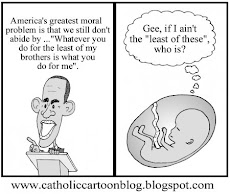

 Posts


